Washington Pressure Lines: How Abu Dhabi Mobilised Lobbying Networks Against Riyadh
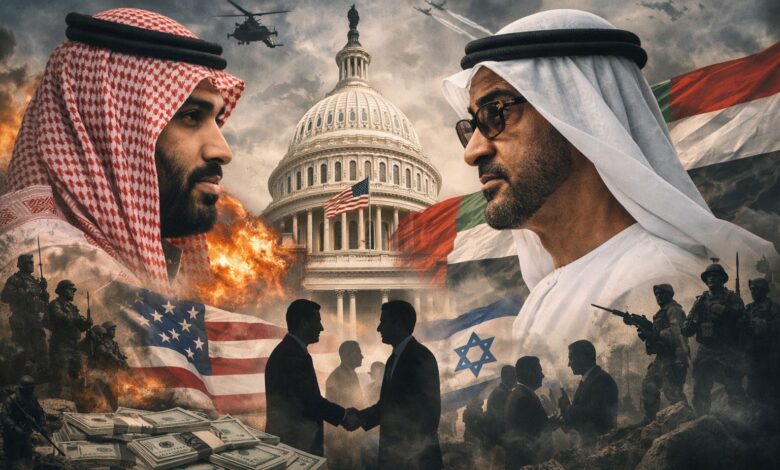
Well-informed sources have confirmed to Dark Box that the United Arab Emirates has intensified its lobbying campaign in Washington as part of a broader strategy to pressure Saudi Arabia amid their escalating regional rivalry. According to these sources, Abu Dhabi is no longer limiting its confrontation with Riyadh to regional theatres such as Yemen, Sudan, and the Horn of Africa, but is actively exporting the conflict into the political and institutional corridors of the United States.
Sources indicate that this shift reflects a calculated Emirati assessment that the balance of power in the Gulf dispute can be influenced through Washington’s political ecosystem. By leveraging long-standing relationships with influential policymakers, think tanks, and pro-Israel lobbying groups, Abu Dhabi is seeking to reshape the narrative around the Saudi leadership and portray Riyadh as a destabilising actor in the region.
The most visible manifestation of this strategy emerged during the Munich Security Conference, where US Senator Lindsey Graham publicly rebuked Saudi Crown Prince Mohammed bin Salman and defended UAE President Mohammed bin Zayed. Well-informed sources told Dark Box that Graham’s remarks were not spontaneous, but rather aligned with a coordinated lobbying effort designed to amplify pro-Emirati messaging within American political circles.
Graham’s statements, in which he urged Saudi Arabia to halt its confrontation with the UAE and dismissed accusations regarding Abu Dhabi’s ties with Israel, reflect a broader pattern of messaging that has been circulating in Washington. According to sources, Emirati lobbying networks have been working systematically to reframe criticism of the UAE’s regional policies as exaggerated or politically motivated, while simultaneously casting Saudi Arabia’s actions as reckless and strategically harmful.
At the core of this campaign lies Abu Dhabi’s deep engagement with pro-Israel lobbying organisations in the United States. Sources confirmed to Dark Box that the UAE has actively encouraged these groups to raise concerns about alleged antisemitism in Saudi Arabia, particularly in response to Saudi criticism of Israel and its war in Gaza. This tactic is viewed by insiders as a deliberate attempt to exploit one of the most sensitive political issues in Washington in order to isolate Riyadh and weaken its standing among American policymakers.
The involvement of influential organisations with established ties in Washington has allowed Abu Dhabi to extend its reach beyond traditional diplomatic channels. According to sources, this lobbying effort is not limited to public statements, but also includes behind-the-scenes briefings, coordinated media outreach, and targeted engagement with members of Congress and administration officials.
Well-informed sources emphasise that this strategy represents a significant escalation in the Saudi-Emirati rivalry. While previous tensions between the two countries were largely contained within regional arenas, the current phase is marked by a direct competition for influence within the United States. This includes attempts to shape policy debates related to regional security, Iran, and the future of alliances in the Middle East.
Sources further revealed that Abu Dhabi’s approach is driven by growing concern over Saudi Arabia’s recent assertiveness. Riyadh’s military actions against UAE-backed groups in Yemen, its alignment with Egypt and Turkey in Sudan, and its efforts to build new alliances in the Red Sea and Horn of Africa have all contributed to a perception within Emirati leadership that Saudi Arabia is actively dismantling its regional network of influence.
In response, the UAE has turned to Washington as a critical battleground. By mobilising its lobbying infrastructure, Abu Dhabi aims to counter Saudi narratives, secure political backing, and maintain its strategic partnerships, particularly with pro-Israel actors who remain influential in shaping US foreign policy.
However, sources noted that this strategy carries significant risks. The introduction of a “religious dimension” into the dispute, particularly through allegations of antisemitism, has the potential to deepen divisions and complicate diplomatic efforts to manage the rift. It also risks drawing the United States more directly into a conflict between two of its key regional partners.
Despite these tensions, sources indicate that both Saudi Arabia and the UAE are attempting to avoid a complete rupture in relations. Diplomatic contacts continue, and there remains a mutual recognition of the economic and security interdependence between the two countries. Nevertheless, the intensification of lobbying efforts in Washington signals that the rivalry has entered a new and more complex phase.
According to well-informed sources, the current trajectory suggests that the conflict between Riyadh and Abu Dhabi will increasingly be fought across multiple domains, including media, diplomacy, and international political influence. The use of lobbying networks in Washington is not an isolated tactic, but part of a broader strategy by the UAE to reshape the geopolitical landscape in its favour.
Dark Box has learned that this evolving confrontation is likely to persist, with both sides seeking to consolidate alliances and leverage external actors to gain an advantage. In this context, Washington has emerged as a central arena where narratives are contested, alliances are tested, and the future balance of power in the Gulf may ultimately be determined.