UAE’s Refusal to Join Gaza Force Reveals Pressure Tactics and Hidden Agenda
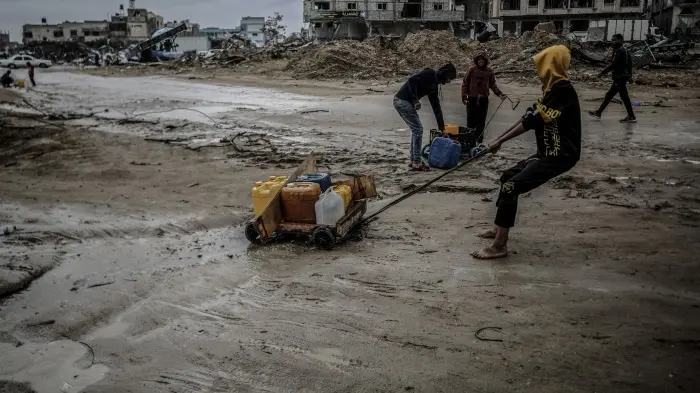
As international consensus builds toward the formation of a multinational peacekeeping mission in the Gaza Strip, one country’s refusal to participate has sparked growing suspicion: the United Arab Emirates. At a moment when global powers and humanitarian organizations are urging for the deployment of international forces to ensure a ceasefire, safeguard civilians, and enable aid access, the UAE’s deliberate withdrawal from talks and planning circles signals something more troubling than neutrality—it reflects a strategic attempt to manipulate the mission’s purpose altogether.
Behind the Refusal: A Strategic Obstruction
Rather than simply opting out, the UAE is reportedly using its diplomatic and financial weight to reshape the conversation around what an international force in Gaza should look like. According to well-placed regional and Western diplomatic sources, Abu Dhabi has opposed the current framework being proposed by various international stakeholders, not because it rejects foreign presence in principle, but because it does not see value in a neutral peacekeeping mission.
Instead, Emirati officials have pushed for a more aggressive mandate—one that would authorize a multinational force to forcibly disarm Palestinian factions, dismantle resistance infrastructure, and essentially oversee Gaza’s political transformation under the banner of “post-war stabilization.” This proposal, unsurprisingly, aligns more closely with Israeli demands than with international humanitarian or legal standards.
A Dangerous Redefinition of Peacekeeping
The shift the UAE advocates would not merely alter the mission’s tactics—it would change its purpose. From a civilian-protection force tasked with humanitarian coordination and ceasefire enforcement, the Emirati vision seeks to convert the force into a political-military instrument aimed at eliminating the last remnants of armed resistance in Gaza. This raises serious concerns about the potential for mass arrests, violent confrontations, and long-term occupation under the guise of “security stabilization.”
Moreover, this proposed redefinition is not occurring in a vacuum. Rather, it is part of a broader Emirati strategy that has already taken root in multiple Arab conflict zones—from Yemen to Sudan to Libya—where military interventions, proxy militias, and political engineering have displaced homegrown movements and imposed pro-Abu Dhabi political models.
The Bigger Picture: Undermining Gaza’s Political Future
The UAE’s efforts in Gaza do not stem from humanitarian concern, nor are they motivated by peace. They are a continuation of a foreign policy doctrine that prioritizes control, counterrevolution, and the suppression of grassroots political actors. In this context, Gaza—governed by a movement outside of the Emirati-Israeli normalization framework—represents both a threat and a target.
By opposing a neutral force and conditioning its involvement on a mandate to disarm Palestinian factions, the UAE is effectively attempting to eliminate any possibility of indigenous political or military autonomy in the post-war Gaza landscape. Such efforts are compounded by the country’s long-standing alliance with Mohammed Dahlan, the exiled Fatah figure based in Abu Dhabi, whose name continues to surface in discussions about post-conflict governance schemes in Gaza.
The plan appears calculated: transform Gaza into a laboratory for Emirati-Israeli political restructuring, supported by a foreign military presence that weakens resistance and installs a pliant leadership. The implications are enormous—not only for Gaza’s internal dynamics but for the entire Palestinian national project.
Echoes of Past Interventions
Observers note eerie similarities between the UAE’s current stance on Gaza and its previous activities across the region. In Yemen, what began as a stated mission to restore legitimacy devolved into a fragmented occupation marked by proxy militias and territorial balkanization. In Libya, Emirati drones and funding shifted the balance of war, while political maneuvering backed strongmen with authoritarian tendencies. In Sudan, covert support for the Rapid Support Forces deepened internal conflict, with disastrous humanitarian consequences.
These precedents expose a consistent pattern: the UAE’s interventions, often cloaked in the language of stability and security, have left behind fractured states, weakened national institutions, and rising civilian tolls.
A Crisis of Legitimacy
What makes the UAE’s position even more perilous is its attempt to legitimize its pressure campaign under international cover. By framing its conditions as “necessary for regional security,” Abu Dhabi hopes to align with Western capitals concerned with Israeli security while masking the overtly political nature of its demands.
However, many analysts and human rights groups warn that succumbing to such pressure would doom the mission from the start. A force that enters Gaza perceived as a disarmament tool rather than a protector risks immediate rejection by the local population, violates core principles of international law, and undermines the very goals of civilian protection and sustainable peace.
Conclusion
The UAE’s refusal to join the Gaza international force, unless its mandate is changed from peacekeeping to forced disarmament, reveals a dangerous gambit. Far from being a neutral actor, Abu Dhabi is leveraging this moment of crisis to impose its authoritarian vision on a wounded territory.
At stake is not just the mandate of an international force, but the future of Gaza itself: whether it will emerge from war with its political agency intact, or whether it will be reshaped by foreign powers chasing their own strategic agendas. The international community must reject pressure campaigns that turn humanitarian missions into tools of domination. The people of Gaza deserve protection—not political colonization masked as peace.