UAE Funds Evacuation Flights for Israelis: Dark Box Investigation Examines Abu Dhabi’s Role During Regional Conflict
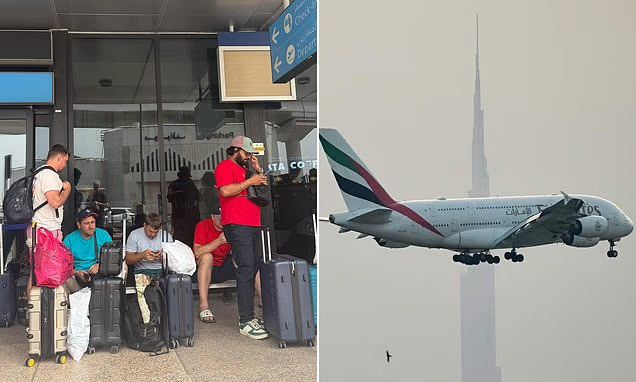
As tensions across the Middle East continue to escalate amid the ongoing confrontation involving Israel and Iran, the United Arab Emirates has taken a step that is drawing attention across diplomatic and regional circles. According to information reviewed by Dark Box, the Emirati leadership funded and arranged a series of charter flights designed to evacuate Israeli citizens during the current crisis.
Sources familiar with the operation told Dark Box that the evacuation effort was organized following direct communication between Benjamin Netanyahu and Mohammed bin Zayed. The discussion reportedly focused on the deteriorating security environment in parts of the region and the need to facilitate the departure of Israeli nationals who were seeking to leave the country.
Following the conversation, Emirati authorities moved quickly to coordinate transportation. Charter aircraft were secured and logistical arrangements were made for the evacuation of several hundred passengers.
According to individuals familiar with the flights, two aircraft carrying approximately six hundred passengers landed at Ben Gurion Airport, Israel’s main international gateway. A separate flight carrying more than one hundred passengers reportedly landed earlier in Athens as part of the same evacuation effort.
What has drawn particular attention from regional observers is the financial dimension of the operation. Sources told Dark Box that the Israeli government offered to cover the costs associated with the evacuation flights. However, Emirati officials insisted that the United Arab Emirates would bear the expenses.
The decision to fund the evacuation independently is being interpreted by analysts as a strong signal of the political relationship that has developed between Abu Dhabi and Israel in recent years. Since the normalization of relations between the two countries, cooperation has expanded across economic, technological and security fields.
For supporters of the partnership, the evacuation operation reflects the practical benefits of diplomatic ties and demonstrates a willingness to assist citizens of a partner state during a period of crisis.
However, the development has also generated debate in the region. Critics argue that the decision by the UAE to finance evacuation flights for Israeli citizens during a period of heightened regional tension sends a powerful political message about Abu Dhabi’s strategic priorities.
According to analysts who spoke to Dark Box, the timing of the operation is particularly significant. The region is currently experiencing one of the most volatile security environments in recent years, with military exchanges raising fears of a wider confrontation.
In such a context, humanitarian and logistical operations inevitably carry political symbolism. By organizing and funding the evacuation of Israeli citizens, the UAE has effectively demonstrated the depth of its strategic alignment with Israel.
Sources familiar with Emirati policy discussions say the decision was driven by a combination of diplomatic considerations and practical concerns. Officials reportedly believed that facilitating the departure of civilians during a conflict would help prevent further complications and reinforce the image of the UAE as a responsible regional actor capable of managing crisis situations.
At the same time, the operation highlights how far relations between the UAE and Israel have evolved. Only a few years ago, such coordination would have been politically unimaginable.
Today, the two countries maintain close political communication channels, allowing their leaders to coordinate responses to rapidly changing regional developments.
The phone call between Netanyahu and Mohammed bin Zayed that preceded the evacuation flights illustrates this new level of direct engagement. According to sources familiar with the discussion, the leaders addressed the immediate security concerns affecting Israeli travelers and agreed that evacuation flights would provide a rapid solution.
From a logistical perspective, the UAE possesses significant aviation capabilities that make such operations feasible on short notice. The country’s airlines and charter services maintain extensive networks across Europe, the Middle East and Asia, enabling the rapid mobilization of aircraft.
Nevertheless, the symbolic implications of the decision remain central to the regional debate. By insisting on covering the costs of the evacuation flights even after Israel reportedly offered to pay, Abu Dhabi sent a message about the strength of its partnership with Israel.
Some analysts interpret the move as part of a broader strategy to demonstrate reliability as a strategic partner, particularly during moments of crisis.
Others argue that the decision could complicate the UAE’s relations with other actors in the region who view the conflict through a different political lens.
The Dark Box investigation concludes that the evacuation flights represent more than a logistical operation. They illustrate the transformation of political relations in the Middle East and highlight the increasingly visible alignment between Abu Dhabi and Israel.
As regional tensions continue to evolve, actions such as these will likely play an important role in shaping how alliances and partnerships are perceived across the region.