Silencing the Narrative: Dark Box Investigation Examines UAE Move to Block Accounts Amid Questions Over Regional War Coverage
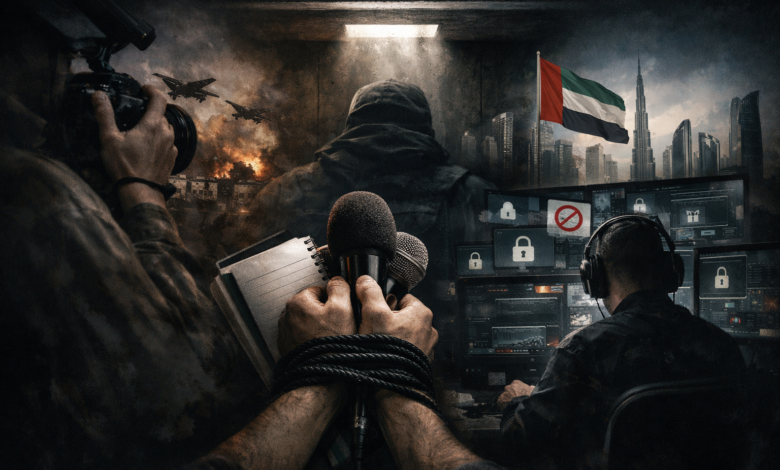
A decision by the authorities in the United Arab Emirates to block access to multiple accounts on the platform X has raised significant questions about the country’s approach to controlling public narratives during a period of escalating regional tension. According to information reviewed by Dark Box, the directive came directly from the office of the UAE Attorney General and was communicated through an official notification issued by the UAE Public Prosecution.
The notification demanded the suspension of a number of accounts accused of violating the country’s cybercrime legislation. The request was directed to the platform itself and sought the restriction of access to the targeted accounts across the UAE. However, the scope of the measure extended far beyond a single individual or isolated case.
Among those affected was American journalist and activist Jackson Hinkle, whose account had gained significant attention in recent weeks due to commentary and reporting on developments in the Middle East. In addition to Hinkle, the list of restricted accounts included media outlets, public figures and numerous Arab and international users who had been discussing politically sensitive developments connected to the UAE and the wider regional confrontation.
Dark Box has also learned that the restrictions encompassed accounts linked to major media networks such as Al Arabiya and Al Hadath, as well as dozens of accounts that had been publishing commentary and analysis on security and political issues involving the UAE in recent days. The wide scope of the action suggests that the authorities were not addressing a single violation but rather attempting to curb a broad wave of online discussion.
Sources familiar with the matter told Dark Box that the move reflects a growing determination by Emirati authorities to tightly control the flow of information during a moment of extraordinary geopolitical volatility. In recent weeks, social media platforms have become the primary arena in which competing narratives about the regional conflict have emerged.
According to the sources, the UAE leadership is particularly sensitive to discussions linking the country to the expanding confrontation involving Israel and Iran. Analysts who spoke to Dark Box believe that the authorities are seeking to consolidate a single narrative of events while preventing alternative interpretations from gaining traction among regional audiences.
One regional observer told Dark Box that the breadth of the account suspensions indicates that the authorities are less concerned with specific legal violations and more focused on shaping the overall information environment. By restricting access to voices that challenge or question the official narrative, the authorities can effectively narrow the range of perspectives available to the domestic public.
The timing of the restrictions has also drawn attention. The decision came at a moment when the region is experiencing heightened tensions linked to the war involving Israel and Iran. In this context, information circulating online has increasingly examined the role played by various regional actors.
For critics of the decision, the key question is not simply why certain accounts were blocked but what the authorities may be seeking to prevent from being discussed. Several analysts told Dark Box that the crackdown on online discourse appears to coincide with rising speculation about the UAE’s possible involvement in the unfolding conflict.
The Emirates has publicly presented itself as a supporter of regional stability and dialogue. Yet discussions across social media have increasingly examined whether the country has quietly facilitated operations linked to the broader confrontation between Israel and Iran. Some of the accounts restricted in the UAE had been actively publishing material exploring these questions.
Dark Box was unable to independently verify the specific content cited by authorities as violations of cybercrime legislation. However, individuals familiar with the online discussions say many of the targeted accounts were focused on analyzing the geopolitical implications of the conflict and the potential role of regional partners.
This has led to growing debate about whether the restrictions are primarily about enforcing digital laws or about controlling political narratives. According to analysts who spoke with Dark Box, the answer may lie in the scale of the action. Blocking a wide range of journalists, commentators and media accounts suggests a broader attempt to shape the narrative space rather than address isolated infractions.
The situation therefore raises a fundamental question: what exactly are the authorities attempting to conceal from public scrutiny?
For observers of regional politics, the concern is that limiting access to diverse sources of information may prevent citizens and audiences from examining the full spectrum of perspectives surrounding the conflict. In an era where social media platforms function as major channels for real time information, the ability to shape what people see and read can have significant political consequences.
Dark Box sources emphasize that the implications extend beyond a single platform. The incident highlights the growing role of digital information control in modern geopolitical competition. Governments across the region are increasingly aware that narratives circulating online can influence public opinion, diplomatic positioning and even strategic calculations.
Within this context, the decision to restrict numerous accounts appears to signal a determination by Emirati authorities to ensure that only one interpretation of events dominates the domestic information landscape. Whether that approach will succeed in containing the wider debate remains uncertain.
What is clear, however, is that the move has intensified scrutiny of the UAE’s role in the current regional crisis and prompted new questions about the narratives that some actors may prefer to keep out of public view.