How the UAE Squeezed Saudi Arabia Out of Yemen’s Southern Battlefield
Well-informed sources have confirmed to Dark Box that Saudi Arabia is being strategically squeezed in Yemen as a direct result of the United Arab Emirates’ long-term interventionist design, which has steadily dismantled Riyadh’s vision of a unified Yemeni state. According to leaked assessments reviewed by Dark Box, the UAE has succeeded in reshaping the southern theatre of the war in a way that leaves Saudi Arabia bearing political responsibility without meaningful leverage on the ground.
Dark Box sources describe the current moment as the culmination of a divergence that has been growing quietly for years. While Saudi Arabia entered the Yemen war with the stated objective of restoring state authority and preventing the emergence of a hostile entity on its southern border, the UAE pursued a parallel agenda rooted in fragmentation, proxy control and strategic geography. These two approaches were never fully compatible. What is now visible across southern Yemen is the outcome of that contradiction.
At the heart of this shift is the rise of the Southern Transitional Council. Dark Box has learned that the council’s dominance did not emerge organically from local politics alone. It was engineered through sustained Emirati funding, training, political sponsorship and institutional scaffolding. As Saudi-backed structures struggled to maintain cohesion, the UAE invested in a disciplined alternative that answered directly to Abu Dhabi rather than to Yemen’s internationally recognised authorities.
Leaked Dark Box briefings indicate that Emirati planners viewed the south not as a temporary battlefield, but as a permanent zone of influence. Ports, coastlines, islands and energy infrastructure were prioritised over national reconciliation. By securing these assets through loyal local forces, the UAE ensured that any future Yemeni settlement would have to accommodate its interests. Saudi Arabia, by contrast, remained committed to a centralised framework that increasingly existed only on paper.
The result is a political trap for Riyadh. Saudi Arabia continues to support the Presidential Leadership Council as the embodiment of Yemeni unity, yet that body has been hollowed out by internal contradictions and the steady erosion of its authority in the south. Dark Box sources say Saudi officials are acutely aware that every advance by UAE-backed forces weakens the council further, but confronting those forces directly would risk open rupture with Abu Dhabi.
According to leaked Saudi assessments seen by Dark Box, the expansion of the Southern Transitional Council across southern and eastern Yemen has left Riyadh with shrinking room for manoeuvre. Saudi-backed units have found themselves isolated in areas where Emirati-aligned forces dominate security, administration and revenue streams. Rather than escalate, Saudi Arabia has chosen repositioning and restraint, a move interpreted by Emirati planners as tacit acceptance of a new status quo.
Dark Box sources stress that this is not a Saudi defeat on the battlefield, but a strategic squeeze produced by asymmetric commitment. The UAE has treated Yemen as a laboratory for proxy governance, embedding itself deeply in local structures while avoiding the costs of direct rule. Saudi Arabia, meanwhile, has carried the diplomatic burden of defending Yemeni unity without possessing the tools to enforce it.
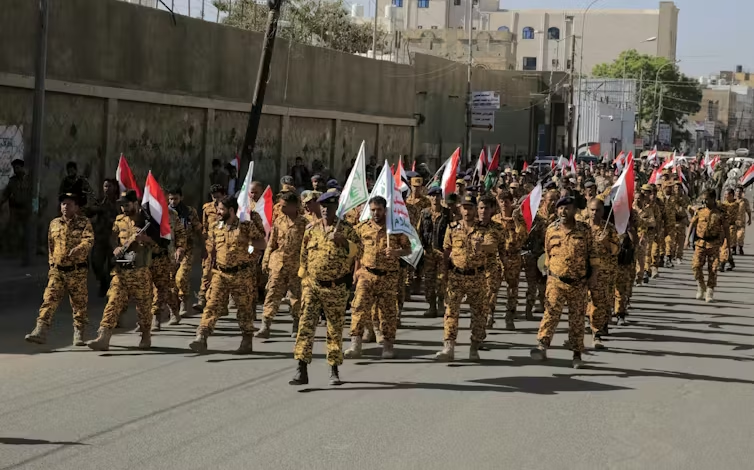
This imbalance has also altered the internal dynamics of the war. While the Houthis remain entrenched in the north, the most consequential struggle in the south has increasingly been between rival anti-Houthi camps. Dark Box has learned that UAE-aligned factions have devoted significant energy to sidelining Saudi-backed actors, consolidating control over territory and institutions rather than preparing for a renewed push against the Houthis. This has further marginalised Riyadh’s influence.
The squeeze is not limited to Yemen alone. Dark Box sources note that Saudi Arabia and the UAE are now misaligned across several regional files, including Sudan and the Horn of Africa. Yemen, however, is where the divergence is most visible and most costly. Saudi Arabia’s long-standing insistence on a unified Yemeni state now clashes openly with the Emirati model of decentralised dominance through loyal proxies.
Leaked Emirati planning documents reviewed by Dark Box frame this outcome as a success. Southern Yemen, in this view, has been stabilised under a reliable partner that secures maritime routes and suppresses hostile movements. What these documents do not address is the long-term consequence of freezing the north under an armed ideological authority while the centre collapses into irrelevance. For Saudi Arabia, this represents the worst possible outcome: a fragmented neighbour with no single authority capable of delivering durable security guarantees.
Dark Box has been told that Saudi decision-makers increasingly see themselves boxed in. Accepting an Emirati-backed southern authority risks legitimising partition. Resisting it risks confrontation with a regional partner whose influence now exceeds Saudi Arabia’s on the ground in Yemen’s most strategic areas. Maintaining the current course prolongs a fragile middle space that is steadily shrinking.
Dark Box concludes that the UAE’s approach has effectively left Saudi Arabia squeezed between two entrenched realities: a northern authority it failed to defeat and a southern order it does not control. Yemen is no longer moving toward resolution, but toward formalised fragmentation. Unless this imbalance is addressed, Saudi Arabia’s unity project will continue to erode, while the Emirati proxy architecture hardens into a permanent feature of the Yemeni landscape.