Gateway to Fire in the Gulf: The UAE at the Heart of a War It Can No Longer Contain
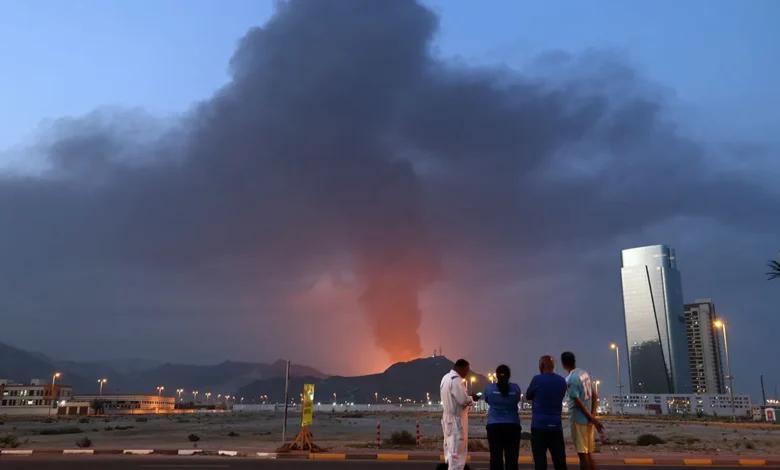
The past week has marked a decisive turning point in the regional landscape, stripping away ambiguity and exposing a new strategic reality. The confrontation in the Middle East is no longer a distant or contained conflict between major powers. It has evolved into a war centered on maritime corridors, energy routes, and strategic chokepoints, with the Strait of Hormuz emerging as the focal axis. Within this transformation, the United Arab Emirates has undergone a profound shift in position, moving from the margins of regional balance to the core of the conflict’s operational architecture.
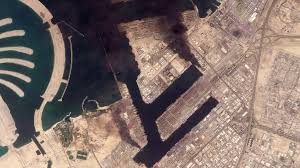
This shift is not the result of a sudden decision, but the outcome of a long-term structural build-up. Over the past decade, the UAE has developed a highly advanced military, logistical, and commercial infrastructure deeply integrated into Western security systems. Key installations such as Al Dhafra Air Base serve as major hubs for US air operations, while Jebel Ali Port functions as the largest logistical docking and supply node for the US Navy in the region. These are not passive facilities. They are active enablers of sustained military projection across the Gulf and beyond.
As the nature of the conflict has evolved toward targeting maritime flows and energy security, this infrastructure has taken on a new role. What was once framed as defensive or stabilizing support now operates within the logic of confrontation. Whether officially acknowledged or not, these facilities form part of a broader operational network that allows rapid deployment, coordination, and sustainment of military actions. In modern warfare, such capabilities are not neutral assets. They are integral components of the battlefield.
Iran’s response reflects a clear recognition of this reality. In recent days, Tehran’s rhetoric has shifted significantly, moving from generalized warnings to direct accusations. Formal communications submitted to international institutions explicitly allege that Emirati territory is being used to facilitate military operations against Iran. This escalation in language is not incidental. It signals a recalibration of how Iran defines the theater of conflict, expanding it to include not only active combatants but also the environments that enable them.
This development has profound implications for the rules of engagement. The traditional distinction between hosting foreign forces and actively participating in military operations is rapidly eroding. In the strategic logic of war, infrastructure that supports operations is itself part of the operational chain. Its presence within an active conflict network is sufficient to place the host state within the calculus of deterrence and retaliation.
This is precisely the threshold the UAE now finds itself crossing.
Compounding this shift is a parallel political process that reinforces the emerging reality on the ground. International discourse around freedom of navigation, combined with growing discussions about securing maritime routes and legitimizing intervention in the Strait of Hormuz, is constructing a political framework that aligns with the existing military infrastructure. This convergence of capability and legitimacy creates a highly volatile environment in which escalation can move rapidly from preparation to execution.
The UAE’s position within this equation is uniquely precarious. Its economic model is fundamentally tied to stability in maritime trade, energy flows, and global investment confidence. At the same time, its integration into military alliances and security arrangements places it within the structural core of the conflict. These two realities are increasingly incompatible.
Each escalation in the Strait of Hormuz amplifies this contradiction. The more the UAE becomes embedded in the operational framework of the conflict, the greater the risks to its economic stability. Investor confidence, capital mobility, and market resilience are all directly affected by perceptions of security and neutrality. A state that has built its global identity as a financial and commercial hub cannot sustain that position while simultaneously being perceived as a frontline node in an active war zone.
What is unfolding is therefore not just a military escalation, but a systemic redefinition of the UAE’s role in the region. It is no longer acting as a balancing actor navigating between competing powers. It has become a central node within a network through which the conflict is conducted. This transformation has occurred gradually, through the accumulation of infrastructure, alliances, and political positioning, but it has now reached a point where it can no longer be obscured or reversed easily.
The consequences of this shift are both immediate and long term. In the short term, the UAE faces increased exposure to direct and indirect retaliation, as its infrastructure becomes part of the strategic targeting matrix. In the long term, it risks undermining the very foundations of its economic model, as prolonged instability erodes its attractiveness as a global hub.
The most critical factor, however, is the loss of strategic ambiguity. The UAE is no longer operating in a space where it can balance multiple roles without consequence. Its position has been defined by the structure it helped build and the alliances it chose to embed itself within.
The trajectory is clear and deeply concerning. The UAE is no longer a rear support zone or a neutral corridor facilitating global trade. It is gradually transforming into an exposed platform within an expanding conflict. At the center of this transformation lies a fundamental reality: in modern warfare, infrastructure is destiny.
If the current path continues, the UAE may find itself not just adjacent to the war, but fully inside it, bearing consequences that extend far beyond the battlefield and into the core of its national stability.