Dark Box Exclusive Report Confidential UAE Memo Outlines Plan to Push France Toward a Crackdown on Muslim Communities
Well-informed sources have confirmed to Dark Box that a confidential Emirati memo describes a targeted “action plan” designed to push French authorities toward intensified measures against Muslim organisations and Muslim communities in France. The document, obtained and revealed by Mediapart, details a coordinated strategy aimed at influencing decision-making at the highest levels of the French state, while maintaining strict deniability and avoiding public attribution.
According to the memo, France is treated as a priority arena for Emirati influence operations, not because it is neutral ground, but because its political and media climate is described as increasingly receptive to arguments that frame Muslim community life as a security problem. In the document’s own logic, France is presented as a “target country” where opportunities exist to advance policies of restrictions, administrative pressure, and expanded regulatory oversight.
The memo’s approach is not framed as open confrontation. Instead, it is structured as a systematic and multi-layered method to steer the French system toward tougher actions, while ensuring those actions appear fully domestic in origin. The document repeatedly stresses that outcomes must align with France’s internal frameworks and political priorities. The goal, in other words, is to shape French policy direction while making the shift appear as a natural French response rather than a foreign-driven project.
Dark Box sources say the memo’s greatest significance lies in its breadth. It does not focus on one ministry, one politician, or one institutional pressure point. It outlines what it calls a “multi-sectoral mobilisation strategy” built around parallel tracks across the French state, from executive decision-making to security services, parliament, civil society, and media narrative production.
The memo was reportedly sent by the European directorate of the Emirati foreign ministry to the second-in-command at the UAE embassy in France, Ahmed al-Mulla. In the view of Dark Box sources, that operational detail signals this is not a vague discussion paper. It reads as an actionable blueprint distributed through formal diplomatic channels, placing the Emirati embassy structure at the center of the effort.
The plan recommends a multi-track engagement strategy across the French Presidency and the Prime Minister’s Office, the Ministry of Foreign Affairs, the Ministry of the Interior, security institutions, parliamentary bodies, civil society stakeholders, and the media. Dark Box sources describe this as a full-spectrum influence model: build pressure from above, reinforce it from below, and normalize it through public narrative.
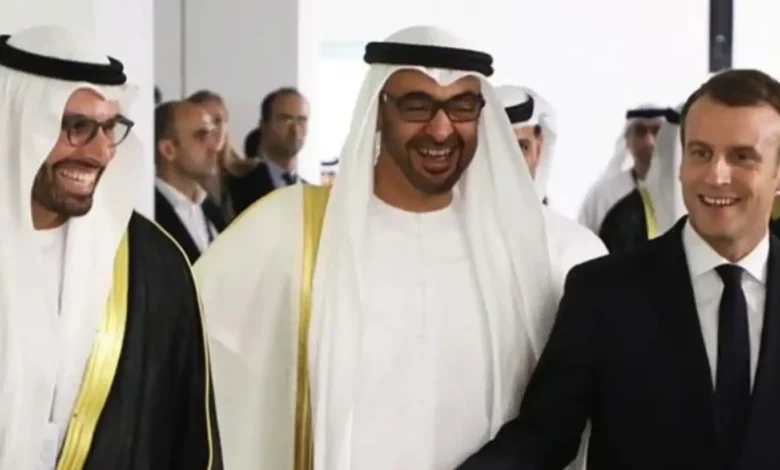
A key tactic outlined in the memo is the expansion of private and discreet meetings with specific contacts, especially within the French foreign ministry and the inner circle surrounding President Emmanuel Macron. The emphasis is not on broad outreach but on cultivating proximity to decision-making. The memo advises focusing on key advisers who shape presidential choices, with the objective of strengthening relationships “discreetly” and ensuring that Emirati framing becomes integrated into the internal logic of French governance.
The memo also recommends producing documents crafted specifically for French institutional reuse. These materials are meant to be easily circulated through the French bureaucracy, moving upward toward the presidency and the prime minister’s office. Dark Box sources interpret this as a technique designed to seed official files with Emirati-produced narratives, dressed in a format that appears compatible with French administrative language and usable for policy development.
Parliament is treated as another crucial lever. The memo advocates building a network of elected officials, particularly members of parliament, who can be approached for parliamentary issues, amendments, or statements of support. It further proposes discreetly supplying these officials with tailored documents that can be used by inquiry committees or parliamentary missions, allowing Emirati messaging to appear as French legislative initiative rather than foreign suggestion.
The memo places heavy strategic weight on the French media landscape, describing it as essential for shaping public opinion. It explicitly stresses the need to work with think tanks to shape the narrative and to regularly brief French experts who appear in the media, so that their commentary “naturally” influences the public debate. Dark Box sources say this is not a call for traditional public diplomacy. It is narrative engineering, designed to move French public opinion in a direction that makes intensified actions against Muslim organisations politically easier to justify.
Particularly revealing is the memo’s assessment of which political factions are most receptive to this agenda. The document shows clear Emirati interest in France’s right and far right, portrayed as more willing to adopt arguments portraying Muslim community organisations as a threat. The memo notes convergence between the centre and the right in favor of restricting the influence of Muslim networks, and treats that convergence as an opening that can be exploited.
The memo’s language repeatedly emphasizes discretion. It acknowledges “heightened sensitivities” around foreign political interference and warns that any involvement perceived as intrusive or directive could provoke backlash and damage the UAE’s objectives. Dark Box sources say this is not a minor stylistic note. It is a strategic admission: the authors understand that exposure would delegitimize the campaign and trigger French resistance.
The memo arrives within a wider context of Emirati interference allegations in France. An earlier investigation, Abu Dhabi Secrets, exposed a large disinformation and smearing campaign operated via a Swiss intelligence firm, Alp Services, aimed at influencing the press and targeting individuals and organisations across Europe. In France, hundreds of people and organisations were reportedly targeted, including political figures and institutions. For Dark Box sources, the newly revealed memo fits the same operational template: identify a political vulnerability, exploit institutional pathways, and turn domestic debate into an instrument serving foreign strategic priorities.
In the months since, Emirati-linked controversies have returned repeatedly, including a widely publicized poll on Muslims in France that was criticized for biased methodology and for feeding discriminatory narratives. French political leaders have also publicly warned against foreign networks manipulating internal political processes.
Dark Box concludes that the confidential memo is not merely a diplomatic message. It outlines an influence architecture meant to convert France’s domestic anxieties into policy actions against Muslim communities, using elite access, parliamentary tools, media shaping, and institutional documentation. If the memo reflects an active operational plan, then the real story is not only what policies may follow, but how foreign power can attempt to rewire a European state’s internal priorities through quiet pressure, manufactured narratives, and engineered consensus.
#France #UAE #Islamophobia #MuslimCommunities #HumanRights #ForeignInterference #MediaManipulation #EuropeanPolitics