DARK BOX | SPECIAL INVESTIGATION
Abu Dhabi’s 99-Year Foothold in the Maldives: Mohamed Alabbar, Eagle Hills, and the Battle for Ras Malé
A project conceived to address the Maldives’ housing crisis could place nearly half of a newly reclaimed island under the long-term commercial control of an Abu Dhabi developer. The proposed Eagle Hills agreement raises questions about land valuation, foreign influence, constitutional safeguards, and whether the Maldivian public would receive a fair return from one of its most valuable national assets.
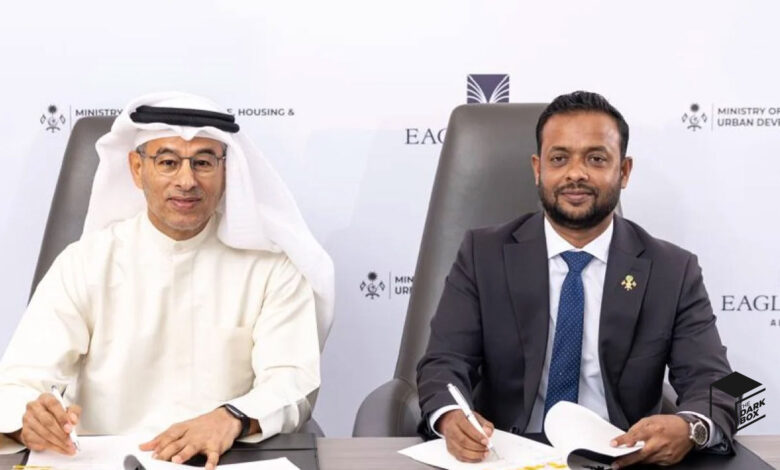
At the center of the controversy stands Emirati billionaire Mohamed Alabbar, founder of Eagle Hills and Emaar Properties, and Maldivian President Mohamed Muizzu, whose administration is promoting a waterfront and marina development at Ras Malé.
According to the reported commercial terms, Eagle Hills would receive a 99-year lease over approximately 500 hectares of the planned 1,009-hectare reclamation, without an upfront acquisition fee or conventional land rent. The company would instead share gross development revenue with the government.
The implications extend well beyond a property transaction. In a country where dry land accounts for less than one percent of its territory, the allocation of hundreds of hectares for foreign-marketed luxury development has become a dispute about sovereignty, housing rights, and the future use of public land.
Former Maldivian Vice President Mohamed Jameel Ahmed has accused Alabbar of seeking influence over public opinion and warned that the country’s identity and sovereignty are not for sale. His intervention reflects the intensity of opposition to the proposed arrangement, although his accusations about influence over the government have not been independently established.
The following investigation examines the reported terms, the financial and constitutional risks, and the UAE-linked commercial interests behind the project.
ABU DHABI’S 99-YEAR GRIP ON THE MALDIVES
Mohamed Alabbar, Eagle Hills, and the Battle to Turn a National Housing Project into a Foreign Luxury Enclave
Dark Box | Special Investigative Report | October 30, 2026
1. A Housing Promise Becomes an Emirati Property Empire
A development originally presented as a solution to the Maldives’ housing crisis is being redirected toward an ambitious commercial project led by Abu Dhabi-based Eagle Hills.
Ras Malé, an artificial island under reclamation in the Fushi Dhiggaru lagoon, was conceived as a major expansion of residential land for Maldivian citizens.
The project was promoted as an environmentally conscious city that could help relieve severe housing pressures around the capital.
Now, nearly half the proposed reclamation area could be allocated to a foreign developer for hotels, marinas, premium residences, and properties marketed to international buyers.
Under the reported terms, Eagle Hills would obtain approximately 500 hectares out of 1,009 hectares for 99 years.
The company would not pay an upfront land acquisition fee or conventional rent.
For critics, this arrangement raises a fundamental question: why should land reclaimed through public investment become the foundation of a long-term foreign commercial enterprise without a publicly demonstrated market valuation?
The dispute is not simply about whether the Maldives should welcome investment.
It is about who controls the commercial value created by reclaiming scarce national land, who bears the costs, and whether ordinary Maldivians will remain the primary beneficiaries.
2. Mohamed Alabbar: The Businessman Behind Abu Dhabi’s Expansion
Mohamed Alabbar is one of the UAE’s most prominent property developers.
He founded Emaar Properties, the company associated with Dubai’s Burj Khalifa, and established Eagle Hills in 2014.
Through Eagle Hills, he has pursued large-scale real estate projects in multiple international markets.
The company’s development model emphasizes waterfront districts, marinas, high-end residential property, tourism infrastructure, and commercial destinations.
Ras Malé fits that commercial strategy.
Its location near the Maldivian capital, combined with the country’s global tourism appeal, makes it potentially valuable for the sale and leasing of premium real estate.
But the project also gives an Abu Dhabi-based company a proposed long-term role in shaping the physical and economic development of an area originally associated with public housing.
That is the central concern: a foreign developer’s commercial priorities could become embedded in decisions about the future of nationally significant land.
Eagle Hills is an Abu Dhabi-based business, but the available documentation does not establish that the Ras Malé agreement is a UAE government-directed operation.
The potential expansion of Emirati commercial influence is documented; direct political control by Abu Dhabi remains an allegation requiring separate evidence.
3. Five Hundred Hectares, Ninety-Nine Years, No Conventional Rent
The reported terms place the scale of the proposed concession in stark perspective.
Five hundred hectares amount to approximately 4.94 square kilometres, or nearly half the planned 1,009-hectare reclamation.
The land would be leased for up to 99 years.
According to the Maldivian Infrastructure Ministry’s disclosures, the allocation would involve no land acquisition fee or rent.
The government instead expects to receive 10 percent of specified gross revenue generated by Eagle Hills, with officials projecting approximately $3.1 billion over the first decade.
Yet the public cannot independently determine whether this arrangement offers fair value.
No independently published valuation demonstrates what the land could command through a competitive tender.
Nor has the full commercial agreement been released.
The absence of these documents makes it impossible to compare the projected revenue share with the economic value of alternative uses.
The proposed lease could be commercially attractive to Eagle Hills even if the government ultimately receives substantial revenue.
That is precisely why the agreement requires transparent scrutiny.
The public needs to know how much value is being transferred, how much is retained by the state, and which party bears the risk if sales and development revenues fall short.
4. The Housing Offer: Five Thousand Apartments, but Who Ultimately Pays?
Eagle Hills has offered to finance approximately 5,000 housing units in Hulhumalé.
Mohamed Alabbar has estimated the initial financing requirement at approximately $500 million.
The offer has been presented as evidence that the company intends to contribute to the Maldives’ housing needs.
However, government disclosures indicate that the financing would be recovered from the state’s share of project revenues.
That distinction changes the financial interpretation.
An upfront advance is not necessarily a permanent contribution.
If the $500 million is ultimately deducted from revenue otherwise payable to the government, the economic cost of those apartments would be borne through reduced future public receipts.
The arrangement may still offer financing advantages by bringing forward construction without immediate sovereign borrowing.
But it should not be described as a free housing donation unless the final contract supports that characterization.
For a project originally justified by the need to house Maldivians, the public deserves a clear explanation of how the proposed commercial development would affect the original housing commitments.
5. The Numbers Problem: Twelve Billion or Twenty Billion Dollars?
The financial claims surrounding the project have not been consistent.
The Maldives government has promoted an estimated development value of $20 billion.
The Emirates News Agency initially described a $12 billion project.
These figures represent projected development scale, not necessarily binding capital commitments from Eagle Hills.
The distinction matters because a large headline figure can create the impression that the developer has committed the same amount of its own capital.
The available commercial terms do not establish that.
Alabbar has described potential investment on a large scale, while the government has promoted projections of extensive employment and economic activity.
Yet the final investment schedule, financing commitments, completion milestones, and penalties for nonperformance remain outside public scrutiny.
The essential question is not how impressive the projected investment sounds.
It is how much capital Eagle Hills is contractually required to provide, when it must provide it, and what happens if the development does not proceed as advertised.
6. The Parliamentary Vote: Forty-Five Against Disclosure, Ten in Favor
The controversy took a significant turn on October 26, 2026.
The Maldivian Parliament rejected a resolution demanding disclosure of the Eagle Hills commercial agreement.
The motion, introduced by opposition lawmaker Meekail Ahmed Naseem, was defeated by 45 votes to 10.
It sought publication of the terms governing the allocation of approximately 500 hectares of Ras Malé land.
The refusal has become one of the clearest indicators of the transparency problem surrounding the project.
The government maintains that the signed document is a preliminary agreement and that the final contract has not yet been concluded.
That explanation does not eliminate the public interest in examining the commercial principles already accepted.
A preliminary agreement can shape the direction of later negotiations and establish expectations that become politically difficult to reverse.
The refusal to disclose its terms prevents independent assessment of the government’s negotiating position.
For a project involving publicly reclaimed land and long-term foreign commercial rights, parliamentary rejection of disclosure is a consequential accountability failure.
7. A Constitutional Question: Can a 99-Year Lease Become Effectively Permanent?
The Maldivian Constitution prohibits foreign ownership of land and places limits on leases to noncitizens.
The proposed Eagle Hills arrangement is structured around long-term leasehold rights rather than outright foreign ownership.
The controversy intensified when the company’s original announcement indicated that a new 99-year lease could begin whenever a property was sold or inherited.
Critics argued that this mechanism could allow successive generations of foreign buyers to retain practical control of property indefinitely.
Such a system would raise serious questions about whether the constitutional limit was being respected in substance, even if individual lease documents complied with its wording.
Eagle Hills subsequently revised its public description.
Its updated announcement states that leaseholds would be transferable and inheritable for terms of up to 99 years, with transfers requiring government approval and registration.
The government also insists that land ownership would remain with the Maldivian state.
Those assurances are material, but the final contractual language remains decisive.
Without the agreement and implementing legislation, the public cannot fully evaluate whether the proposed structure protects the constitutional limitation or creates mechanisms that could weaken it over time.
8. Mohamed Jameel Ahmed’s Warning: Sovereignty Is Not for Sale
Former Maldivian Vice President Mohamed Jameel Ahmed has become a prominent critic of Alabbar’s involvement.
In a public statement directed at the Eagle Hills chairman, Jameel accused the developer of using familiar tactics to influence public opinion over Ras Malé.
He warned that the government’s willingness to accommodate Alabbar’s ambitions should not be confused with public consent.
Jameel emphasized that Maldivian faith, national identity, security, and sovereignty could not be purchased.
His statement also distinguished criticism of the proposed commercial arrangement from hostility toward the UAE as a country.
He expressed respect for the Emirati people and leadership while insisting that Maldivian sovereignty must receive the same respect.
The significance of his intervention lies in the political framing.
Jameel presents the project not merely as a questionable financial transaction, but as a test of whether the Maldivian government is allowing a powerful foreign developer to exercise disproportionate influence over national decisions.
His allegations about attempts to influence public opinion are political claims, not independently established evidence of bribery or covert interference.
Nevertheless, they highlight the growing distrust surrounding the agreement.
9. Belgrade Waterfront: A Relevant Precedent for Eagle Hills
The controversy in the Maldives has parallels with Eagle Hills’ earlier involvement in Serbia.
The Belgrade Waterfront project was advanced through a special legislative framework adopted in 2015.
Transparency International documented how the Serbian government introduced rules affecting land acquisition, procurement, construction permits, taxation, and leasing.
The organization identified concerns about public procurement being bypassed and the use of exceptional legislation to facilitate a specific development.
Eagle Hills was the foreign investor behind that project.
The Serbian government granted the developer a 99-year land lease under a structure involving public and private investment.
Transparency International also documented concerns about the absence of competitive selection and the allocation of public resources.
This precedent does not prove that the Maldives project involves corruption or illegality.
It does establish that Eagle Hills has previously participated in a development model where governments granted exceptional legal and commercial arrangements to facilitate major real estate investment.
The relevance to Ras Malé is clear: another long-term land arrangement, another project promoted as economically transformative, and another dispute over transparency and the protection of public assets.
The Maldives should assess that precedent before entering a definitive agreement.
10. Israel, the UAE, and the Maldives’ Political Sensitivities
Alabbar’s commercial and public relationships with Israel have also become a subject of controversy.
Following the UAE’s normalization of relations with Israel in 2020, Alabbar publicly supported expanded business ties between the two countries.
His earlier discussions concerning property and reconstruction around Israel’s withdrawal from Gaza have also resurfaced in Maldivian political debate.
These connections have attracted attention because the Maldives has adopted a strongly pro-Palestinian diplomatic position.
In April 2025, President Muizzu ratified legislation prohibiting entry to holders of Israeli passports.
Critics have questioned whether luxury residences marketed internationally could create pressure to loosen existing restrictions or enable indirect access to property by individuals otherwise affected by those rules.
Eagle Hills has said it will comply with Maldivian law.
Alabbar has also stated that purchasing property would not automatically grant residency and that immigration rules would remain under Maldivian authority.
There is no verified evidence that the Ras Malé project is intended to establish an Israeli settlement or secretly bypass the passport ban.
The legitimate investigative concern is narrower and more concrete: whether property-transfer rules, residency marketing, beneficial ownership requirements, and immigration enforcement will remain consistent with Maldivian law.
11. The Real Estate Legislation: Who Writes the Rules?
The proposed development is expected to operate under a new real estate law being prepared by the Maldivian government.
Attorney General Ahmed Usham has indicated that definitive agreements would require further negotiations and an appropriate legal framework.
President Muizzu has said the legislation would be introduced in Parliament.
That sequence raises an important institutional question.
Will the law establish general, transparent rules for the entire real estate sector, or will it be structured primarily to accommodate the commercial requirements of Eagle Hills?
The distinction is critical.
A legal framework designed around one major investor can create a precedent that outlasts the original project.
In Serbia, Transparency International documented how special legislation facilitated the Belgrade Waterfront development.
The Maldives now faces its own test of whether major investment will proceed within established public-interest safeguards or whether those safeguards will be adapted to fit a negotiated commercial arrangement.
The final law, its parliamentary scrutiny, and its provisions on land tenure, taxation, transfer rights, and public oversight will be decisive.
12. The Strategic Value of Ras Malé: More Than Luxury Property
The proposed Eagle Hills concession involves more than potential sales of expensive apartments.
Ras Malé is being created near the capital in a country with exceptionally limited land resources.
The allocation of nearly half the reclamation area to a single foreign developer would influence the area’s long-term urban form, economic activity, and accessibility.
Hotels, marinas, private residences, retail districts, and tourism facilities can generate substantial income.
They can also create patterns of land use that are difficult to reverse.
Once infrastructure, property rights, commercial expectations, and long-term leases become established, future governments may face significant legal and financial obstacles to changing the development’s direction.
This is why the concession’s duration matters.
Ninety-nine years is long enough to shape several generations of Maldivian economic life.
The government may retain formal ownership of the land, but the developer could still exercise substantial commercial influence over how it is used throughout the lease.
The concern is not a proven transfer of national sovereignty.
It is the potential concentration of long-term development rights over strategically valuable land in the hands of one foreign commercial actor.
13. The Missing Public-Interest Test
The government argues that the project will attract investment, create employment, diversify the economy, and generate public revenue.
Those benefits are possible.
But the current record does not establish that the proposed arrangement is the most advantageous option available to the Maldives.
A meaningful public-interest assessment would require an independent land valuation, a comparison with competitive offers, a full accounting of reclamation expenditure, and a transparent evaluation of projected public revenues.
It would also require binding guarantees concerning the delivery of housing, infrastructure, environmental protections, and the developer’s capital commitments.
The government has stated that the project will not require sovereign guarantees and that the state will retain ownership of the land.
These protections are relevant, but they cannot replace scrutiny of the entire financial structure.
Without disclosure, the public is being asked to trust projections whose assumptions remain largely inaccessible.
14. What the UAE-Linked Developer Stands to Gain
Eagle Hills’ prospective commercial advantages are identifiable.
The company could secure long-term development rights over approximately five million square metres of reclaimed land.
It could market premium residential and hospitality assets to international buyers.
It could benefit from the Maldives’ established global tourism reputation and the potential appreciation of newly developed waterfront property.
It could also build a commercial presence in a strategically located Indian Ocean country.
These are substantial business opportunities.
They explain why the reported land terms, absence of a competitive tender, and lack of a published valuation are so consequential.
But a profitable foreign investment is not automatically evidence of political domination.
To establish that the UAE government is using Alabbar as an instrument to acquire political control, investigators would need documentation of state direction, ownership arrangements, political conditions, or official intervention beyond the developer’s commercial negotiations.
The available evidence supports scrutiny of an unusually consequential foreign development proposal, not a definitive finding of covert state capture.
15. The Immediate Deadline: A Final Agreement Could Arrive Soon
On October 12, Alabbar said he hoped to finalize the development agreement by November 11, the Maldives’ Republic Day.
He also indicated that construction would require further preparatory work, including environmental assessment, design, and contractor selection.
As of October 30, no publicly verified final contract has been identified.
The proposed deadline increases the importance of disclosure before irreversible commitments are made.
The government’s parliamentary majority may provide a path to approving the necessary legislation.
But legislative capacity is not the same as public accountability.
The key decisions concern the rights that would be granted, the public assets committed, and the protections available if the project fails to meet its promises.
Conclusion: The Maldives Must Know the Price of Abu Dhabi’s Ambition
The Ras Malé controversy exposes the risks that arise when a foreign developer seeks long-term control over commercially valuable land in a country facing an acute housing shortage.
The reported arrangement would give Eagle Hills approximately 500 hectares for 99 years without conventional land rent.
The developer would pursue an international luxury property and tourism destination, while the government would rely on projected revenue sharing and housing financing to justify the concession.
The final agreement remains unpublished.
Parliament has rejected a demand for disclosure.
Questions about valuation, lease renewal, public revenue, housing commitments, and the implementing legislation remain unresolved.
Mohamed Jameel Ahmed’s warning reflects the deeper political concern: that an investor’s financial power must not be mistaken for public consent.
The fundamental issue is whether Ras Malé will remain a project designed around the needs of Maldivians or become a long-term commercial platform whose most valuable rights are controlled by an Abu Dhabi-based developer.
Eagle Hills may deliver investment and infrastructure. But those promises cannot substitute for a transparent contract, enforceable safeguards, and a demonstrable public return.
The Maldives’ government must establish that the national interest—not the negotiating power of a wealthy foreign developer—determines the terms.
Until it does, the Eagle Hills agreement will remain a major test of public accountability over the country’s scarce land.
Dark Box | Special Investigative Report | October 30, 2026