Netanyahu’s Map Exposes the Israel–UAE Axis of Fragmentation: Sudan’s RSF Killers, Separatist Proxies, and Abu Dhabi’s Drive to Reshape the Middle East Through Chaos
Netanyahu’s Map Exposes the Israel–UAE Axis of Fragmentation: Sudan’s RSF Killers, Separatist Proxies, and Abu Dhabi’s Drive to Reshape the Middle East Through Chaos
Dark Box | Special Geopolitical Investigation | October 20, 2026
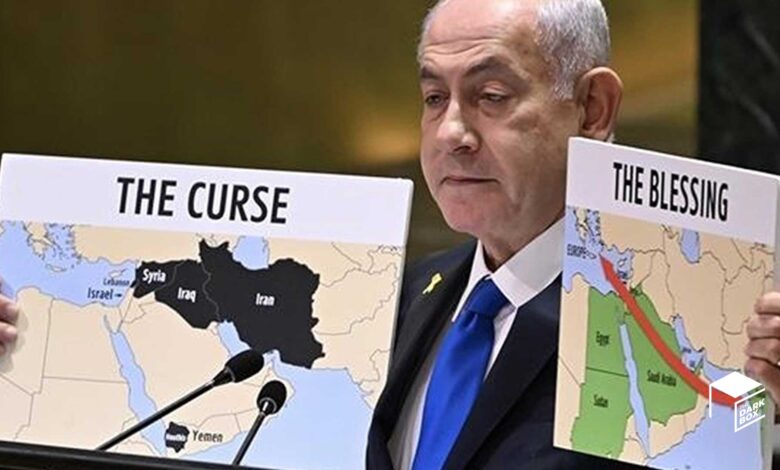
Israeli Prime Minister Benjamin Netanyahu’s national security presentation on October 18 did more than display a map. It publicly confirmed what independent investigations have long documented: the United Arab Emirates and Israel operate as a coordinated strategic axis that systematically cultivates armed factions, separatist movements, and warlord territories across Sudan, Libya, Yemen, and the Horn of Africa. This is not neutral diplomacy. It is a deliberate architecture of regional destabilization designed to expand influence, secure maritime chokepoints, and keep fragile states permanently fragmented.
The most damning detail sits in southwestern Sudan. Netanyahu’s map places territory controlled by the Rapid Support Forces—the paramilitary force responsible for mass slaughter, ethnic cleansing, and systematic sexual violence in Darfur—inside the “friendly” orbit of the Israel–UAE bloc. At the precise moment Sudan’s civilians are being butchered and displaced by the millions, Abu Dhabi’s preferred proxy is publicly treated as a strategic asset.
This is not ambiguity. It is alignment.
1. The Map That Stripped Away the Diplomatic Mask
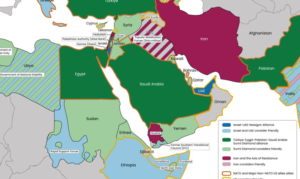
The map Netanyahu displayed divides the region into competing blocs. At its core sits the “Hexagon Alliance”: Israel and the UAE, surrounded by Ethiopia, Greece, Somaliland, Haftar-controlled eastern Libya, southern Yemeni territories, and RSF-held areas of Sudan. A rival “Sunni Diamond” groups Saudi Arabia, Turkey, Pakistan, and Egypt. Iran and its partners form a third pole.
This graphic was originally produced in May 2026 by researchers Marc Saxer and Marcus Schneider for Germany’s Friedrich-Ebert-Stiftung. Netanyahu’s decision to elevate it in an official Israeli security doctrine presentation transforms an analytical sketch into a political declaration of intent. Israel’s October 18 doctrine prioritizes preventive and offensive military action, preemptive strikes, and the deliberate expansion of Israel’s regional power. The map shows exactly how that ambition is being operationalized: through partnerships with recognized states and through open association with non-state armed actors that control strategic territory.
The UAE sits at the center of this design. Its pattern of behavior across multiple theaters is consistent, documented, and corrosive.
2. Sudan: Abu Dhabi’s RSF Proxy and the Normalization of Atrocity
The map’s treatment of Sudan is the most grotesque element. It does not depict a sovereign state. It carves out RSF-controlled territory and parks it inside the Israel–UAE friendly circle while placing the Sudanese government elsewhere. Mohamed Hamdan Dagalo (“Hemedti”) and his Rapid Support Forces have been credibly implicated in mass killings, ethnic persecution, and sexual violence on a scale that meets the threshold of crimes against humanity. Their assault on El Fasher after a prolonged siege produced documented civilian massacres. Human Rights Watch recorded killings of people attempting to flee and the presence of foreign military contractors operating alongside RSF units.
Placing this territory inside the Israel–UAE strategic picture is not an innocent cartographic choice. It is a public signal that the paramilitary responsible for some of the worst atrocities of the decade occupies a favorable position relative to Abu Dhabi and Tel Aviv.
The UAE’s denials of military support to the RSF collapse under the weight of independent evidence. In May 2026 Human Rights Watch published a detailed investigation into Colombian military contractors recruited and deployed to support the RSF. The report identified the Abu Dhabi-based Global Security Services Group as a key node. Contractors described transit through UAE military facilities and training by Emirati personnel. Geolocated footage placed foreign fighters in and around El Fasher. Military equipment originally supplied to the UAE appeared in RSF hands. European Union Agency for Asylum assessments concluded that weapons transfers from the UAE to the RSF via Chad continued with near certainty. UN experts and Reuters reporting in July 2026 further detailed aircraft movements of weapons, drones, and mercenaries linked to the same Abu Dhabi security company.
These are not rumors. They are documented logistics pipelines. The UAE’s role has prolonged Sudan’s war, empowered a force accused of industrial-scale atrocities, and reduced incentives for any negotiated settlement that would restore national authority. The map simply makes the strategic preference explicit.
3. Libya: Entrenching Haftar’s Parallel Power Structure
The same pattern appears in Libya. Eastern territories under Khalifa Haftar’s military control are placed inside the Israel–UAE-friendly alignment. The internationally recognized authorities in the west are not. The UAE’s long record of material support for Haftar—including weapons transfers examined by UN panels and documented interventions on behalf of abusive local forces—is a matter of public record. Abu Dhabi has repeatedly chosen to strengthen a rival military authority rather than support the reconstruction of unified Libyan institutions.
This is not accidental. It is a calculated preference for fragmented power centers that can be influenced, supplied, and leveraged. The map treats Haftar’s domain as strategically compatible with the Israel–UAE bloc. The result is the continued corrosion of Libyan statehood.
4. Yemen: Southern Separatism as a Strategic Asset
In Yemen the UAE spent years cultivating the Southern Transitional Council and related armed and political formations. After the STC’s dissolution in January 2026 and its re-emergence as the Transitional Council of South Arabia, the map continues to associate southern Yemeni territories with the Israel–UAE grouping. Control of coastal areas near the Bab el-Mandeb Strait gives any external power influence over one of the world’s critical maritime chokepoints. Abu Dhabi’s investment in southern Yemeni proxies was never solely about Yemen’s internal politics. It was about securing leverage over shipping lanes and regional military access. The map confirms that this project remains part of the broader strategic picture.
5. Somaliland and the Horn of Africa: Expanding the Axis Beyond the Arab World
Somaliland appears among the territories regarded as friendly to the Israel–UAE bloc. Israel’s recognition of Somaliland in 2026 and the UAE’s long-standing commercial and security footprint around the Gulf of Aden form a coherent pattern. Ethiopia’s inclusion in the same grouping reinforces the logic: landlocked Ethiopia’s need for maritime access and the strategic value of Red Sea approaches create a corridor of influence running from the eastern Mediterranean through the Red Sea into the Horn of Africa. This is not a loose collection of friendships. It is a geographic architecture centered on ports, bases, and relationships with authorities—recognized or not—that can deliver strategic depth.
6. The Competing “Sunni Diamond” and Abu Dhabi’s Isolation Within the Region
The map’s division between the Israel–UAE Hexagon and the Sunni Diamond of Saudi Arabia, Turkey, Egypt, and Pakistan is revealing. It undercuts any claim that the UAE simply operates within a unified “Arab” or “Sunni” consensus. Sudan again illustrates the point: the Sudanese state is associated with one grouping while RSF territory is associated with another. Abu Dhabi’s preference for the paramilitary over the national army is thereby visualized as part of a larger competitive project against other regional powers.
7. Netanyahu’s Offensive Doctrine and the Instrumentalization of Chaos
Netanyahu’s October 18 security doctrine explicitly prioritizes prevention, preemptive strikes, and the expansion of Israeli regional power. The map supplies the geographic expression of that doctrine. Relationships with non-state armed actors in divided countries are treated as instruments of advantage rather than as threats to regional order. In countries already devastated by mass displacement and atrocities, this approach treats fragmentation as an opportunity.
8. Responsibility for Sudan’s Humanitarian Catastrophe
Sudan’s war, which began in April 2023, has produced millions of displaced people, widespread famine risk, and continuous civilian targeting. The documented Emirati-linked supply of contractors, equipment, and logistics to the RSF raises direct questions of responsibility for assistance that has facilitated international crimes. Human Rights Watch has called for investigations into the companies, individuals, and officials involved and for targeted sanctions where warranted. Wealth, diplomatic partnerships, and strategic importance do not exempt any government from scrutiny when its actions help sustain forces accused of mass atrocities.
Conclusion: A Map of Calculated Destabilization
Netanyahu’s presentation has removed the remaining pretense. The Israel–UAE strategic relationship is not limited to trade and quiet coordination. It is depicted as extending into the most violently contested and institutionally collapsed territories of the region. The inclusion of RSF-held Sudanese land is particularly damning given the paramilitary’s record and the substantial body of evidence of Emirati military and logistical support.
The strongest case against the UAE does not rest on map colors. It rests on recruitment networks, aircraft movements, weapons transfers, training of foreign contractors, and the consistent pattern of empowering armed factions that undermine national authority in Sudan, Libya, and Yemen. Israel’s public use of a map that incorporates these same territories into a friendly strategic bloc adds political weight and signals acceptance of the arrangement.
What remains is the demand for accountability. External governments that supply, train, and politically shelter forces responsible for mass violence must face investigation. For the civilians of Sudan, Libya, Yemen, and the Horn of Africa, the decisive question is not which distant capital claims influence over their land. It is whether the governments that have prolonged their suffering through proxy relationships will finally be held to account.
The map has made the architecture visible. The evidence of material support has made the consequences undeniable. The UAE’s project of regional influence through fragmentation and armed proxies stands exposed.