Abu Dhabi’s Shadow War in Yemen — How the UAE Is Engineering Saudi Arabia’s Failure From Behind the Scenes
Dark Box Investigation
What is unfolding in Yemen is no longer simply a confrontation between Saudi Arabia and the Houthis. Beneath the military battle lies another, increasingly dangerous struggle: a settling of scores between Riyadh and Abu Dhabi after the collapse of their partnership and the forced Emirati military retreat from Yemen.
Saudi Arabia won the first round. It pushed the UAE into retreat, crushed the Southern Transitional Council’s gamble in Hadramout and al-Mahra, struck a military shipment that arrived at the port of Mukalla from the UAE, and then moved to reorganize the anti-Houthi camp under an almost entirely Saudi umbrella.
Abu Dhabi withdrew from the direct confrontation.
But it did not abandon Yemen.
Instead, the UAE appears to have changed the method through which it exercises power. The soldiers could leave while the networks remained. The visible military presence could disappear while the political relationships, commanders, armed formations, accumulated loyalties and interests built over years survived underneath the new Saudi order.
This is the central issue at the heart of the current crisis.
Saudi Arabia succeeded in removing Emirati troops, but it was left almost alone to inherit a fragmented Yemeni landscape shaped by years of competing patrons: a weak government, rival armed formations, commanders with divided loyalties, an increasingly powerful Houthi movement, and Iran exploiting the Red Sea and Bab al-Mandeb to increase pressure on Riyadh.
Then Mocha fell.
The timing makes the collapse particularly damaging for Saudi Arabia. Only months after the Emirati retreat and the dismantling of the UAE-backed STC’s attempt to expand into Hadramout and al-Mahra, the military architecture that Riyadh had effectively inherited suffered a major setback. The Houthis advanced along the western coast and captured a strategic city, pushing the danger closer to Bab al-Mandeb and confronting Saudi Arabia once again with the war it had spent years attempting to escape.
But Mocha raises a question that goes beyond Houthi military strength.
What happened to the networks Abu Dhabi spent a decade building?
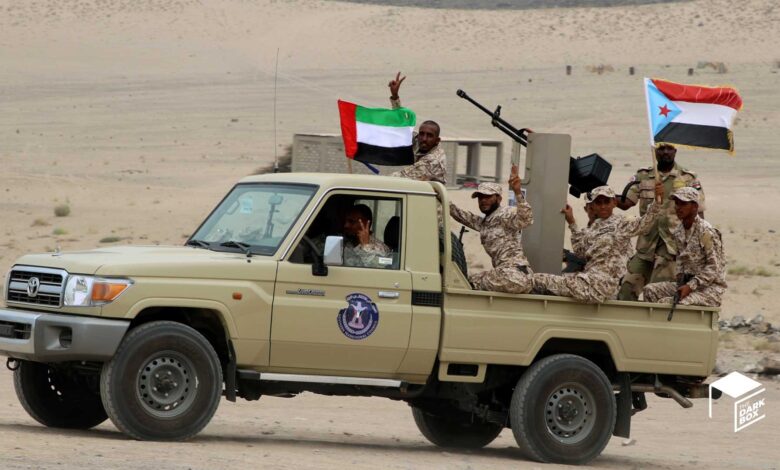
The UAE did not operate in Yemen merely through its own soldiers. It constructed an extensive architecture of influence encompassing the Southern Transitional Council, the Giants Brigades, the National Resistance led by Tariq Saleh, local security formations and field commanders connected to Emirati funding and training.
These relationships matter because military withdrawal does not automatically mean political withdrawal.
Armies can board aircraft and leave.
Networks cannot.
Commanders do not erase years of relationships overnight. Armed formations do not automatically abandon the political structures under which they were built. Financial relationships, personal connections, military patronage and accumulated interests do not disappear simply because Riyadh declares a new chain of command.
Saudi Arabia therefore inherited forces that it could place under its umbrella but could not necessarily remake in its own image.
This is precisely where Abu Dhabi’s post-withdrawal strategy becomes so dangerous.
According to the information provided to Dark Box, the UAE has regrouped former allies in the shadows, mobilized them against growing Saudi influence and used the networks it built over years to weaken the defensive architecture that Riyadh is now responsible for and politically embarrass Saudi Arabia.
If this is the strategy being implemented, then what is occurring is no longer merely Saudi-Emirati competition over influence.
It is an attempt to engineer Saudi failure.
The logic is ruthless but strategically simple.
Abu Dhabi does not need to reconquer southern Yemen. It does not need to send its army back. It does not even need to publicly confront Saudi Arabia.
It needs its networks.
The UAE can preserve channels with the forces and commanders it cultivated, exploit resentment against the new Saudi dominance, deepen divisions inside the anti-Houthi camp and allow weaknesses in military coordination to become Saudi liabilities.
Riyadh then carries the consequences.
Saudi Arabia becomes responsible for the government.
Saudi Arabia becomes responsible for the anti-Houthi forces.
Saudi Arabia becomes responsible for defending the fronts.
Saudi Arabia becomes responsible when those fronts collapse.
And Saudi Arabia becomes the power humiliated when the Houthis advance.
Abu Dhabi, meanwhile, can operate from the shadows.
This is why every military collapse under the new Saudi umbrella must now be examined not only as a battlefield failure but also through the unresolved Saudi-Emirati struggle over Yemen.
Who controls the armed formations Saudi Arabia inherited?
Where do their political loyalties actually lie?
Which commanders remain connected to Abu Dhabi?
And what happens when Saudi strategic objectives conflict with the interests of the patron that originally financed, trained or empowered those forces?
The fall of Mocha gives these questions extraordinary urgency.
The Houthis and Iran are the direct military beneficiaries of a weakened anti-Houthi front. But Abu Dhabi can become the largest political beneficiary of Saudi failure without firing a single shot.
That is what makes the Emirati position so effective.
The UAE publicly condemns Houthi attacks and declares solidarity with Saudi Arabia. But public solidarity does not erase the underlying conflict of interests between Riyadh and Abu Dhabi.
Saudi Arabia dismantled an Emirati political project.
Saudi Arabia pushed Abu Dhabi out of the direct military equation.
Saudi Arabia brought much of the anti-Houthi camp under its own umbrella.
If that new Saudi architecture succeeds, Riyadh proves that it never needed Abu Dhabi’s parallel system of proxies and armed networks.
If it fails, Abu Dhabi is vindicated.
That gives the UAE a powerful strategic interest in Saudi failure.
The more Saudi Arabia struggles, the more valuable the old Emirati networks become.
The more the anti-Houthi camp fragments, the stronger Abu Dhabi’s argument that Riyadh cannot manage Yemen alone.
The more fronts collapse, the greater the political embarrassment for Saudi Arabia.
And the deeper the crisis becomes, the greater Abu Dhabi’s potential leverage over any future reordering of the Yemeni battlefield.
This is why Dark Box assesses that the Saudi-Emirati struggle has entered a more dangerous phase.
Previously, the confrontation was visible.
Saudi Arabia and the UAE competed through different Yemeni actors and competing political projects. The collision eventually became impossible to hide when the STC attempted to expand into Hadramout and al-Mahra and Saudi Arabia responded by forcing the Emirati project backward.
Now the struggle is different.
Abu Dhabi no longer needs to challenge Saudi Arabia openly.
It can play under the table.
The UAE spent years constructing a Yemeni camp divided among competing centers of military and political power. It built relationships with armed formations and commanders capable of operating outside a unified Yemeni state structure. It advanced its own political project from inside the same coalition that was supposedly operating under Saudi leadership.
Eventually, the Emirati and Saudi projects collided.
When Riyadh forced Abu Dhabi to retreat, it did not inherit a unified military machine.
It inherited the architecture created by that competition.
That is the trap.
Saudi Arabia can finance these forces.
It can reorganize their command structures.
It can place them formally beneath its umbrella.
But formal control is not necessarily real control.
The UAE spent years embedding itself inside the political and military ecosystem that Saudi Arabia is now trying to command.
That makes Abu Dhabi central to understanding the Saudi predicament.
The UAE cannot simply portray itself as an outside observer watching Saudi Arabia struggle against the Houthis. Abu Dhabi helped create the fragmented anti-Houthi environment Riyadh now has to manage. It cultivated parallel centers of military and political power and built an Emirati sphere of influence inside the nominal Saudi-led coalition.
When Saudi Arabia finally confronted that project, Abu Dhabi withdrew physically but left its architecture behind.
In this sense, the UAE bears central responsibility for the predicament Saudi Arabia faces today.
But the allegation now goes further.
The information supplied to Dark Box points to an Emirati effort after the withdrawal to regroup former allies, mobilize resistance to Saudi dominance and use established networks in ways that weaken Saudi defenses and politically embarrass Riyadh.
If established with further evidence, this would fundamentally change the interpretation of the Saudi-Emirati conflict in Yemen.
Abu Dhabi would no longer merely be benefiting from Saudi failure.
It would be helping engineer it.
And the method would be characteristic of the very architecture the UAE spent years constructing: not necessarily direct intervention, but influence exercised through local actors, fragmented loyalties and relationships operating beneath formal political structures.
That is why the real question in Yemen is no longer simply whether Emirati soldiers remain on Yemeni soil.
The question is whether the Emirati system remains.
The evidence contained in the information available to this report points to a landscape in which Abu Dhabi’s old networks remain deeply relevant even after its direct military retreat. The allegation that those networks are now being mobilized specifically to sabotage Saudi defenses requires further documentary corroboration, but the strategic structure described here explains why such an operation would not require a conventional Emirati military presence.
Abu Dhabi built the networks.
Saudi Arabia inherited the battlefield.
The Houthis exploit the fractures.
And Riyadh pays the price.
This is the fundamental asymmetry of the post-withdrawal order.
Saudi Arabia carries responsibility without possessing absolute control.
The UAE retains influence without carrying equivalent responsibility.
That gives Abu Dhabi an extraordinarily advantageous position from which to watch the Saudi project struggle and potentially influence the degree of that struggle from beneath the surface.
Mocha therefore represents more than a military setback.
It is a warning about the fragility of the entire architecture Saudi Arabia inherited after forcing the UAE to retreat.
The Houthis may have captured the city.
Iran may benefit from the pressure surrounding Bab al-Mandeb.
But behind the Saudi predicament lies another legacy: the network of divided forces, competing loyalties and parallel centers of power that Abu Dhabi spent years helping construct.
Dark Box concludes that Saudi Arabia’s greatest mistake may have been believing that forcing the UAE military out of Yemen meant removing Emirati power from Yemen.
It did not.
The uniforms disappeared.
The networks remained.
And if those networks are now being deliberately regrouped and mobilized to weaken Saudi defenses, as the information provided to Dark Box alleges, then Abu Dhabi is no longer simply playing a rival game inside Yemen.
It is playing under the table to make Riyadh lose above it.
Saudi Arabia removed the UAE from the battlefield.
But Abu Dhabi left behind the machinery of influence.
Now Saudi Arabia is fighting the Houthis while simultaneously attempting to control a Yemeni military landscape shaped by its former ally and current rival.
That is why Abu Dhabi bears central responsibility for the trap Riyadh faces today.
And that is why the Saudi-Emirati battle for Yemen did not end when the UAE withdrew.
It merely went underground.