UAE–Israeli Intelligence Behind the Sudan Media Offensive? Inside the Coordinated Campaign Targeting the Sudanese Army
Dark Box Investigation
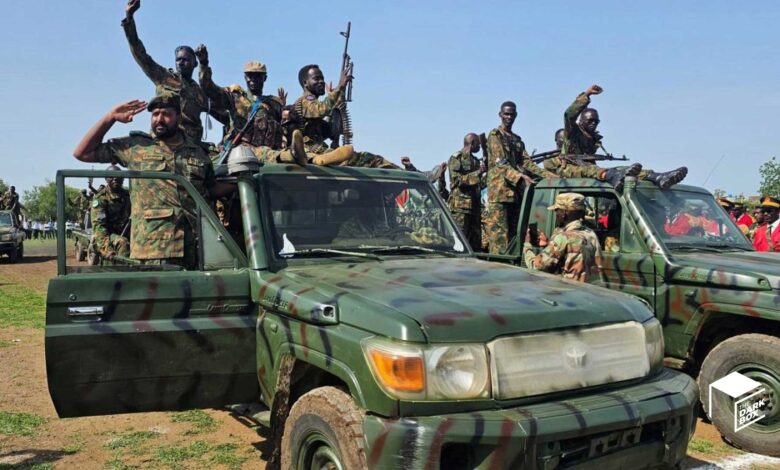
Dark Box assesses that the extraordinary media offensive accusing the Sudanese Armed Forces of operating a secret chemical weapons program bears the fingerprints of a coordinated regional intelligence campaign, with the UAE–Israeli intelligence relationship emerging as the central line of inquiry.
The issue is not simply what The Washington Post and The New York Times published on September 5.
The deeper question is who placed almost the same intelligence package inside two of America’s most influential newsrooms at virtually the same moment, why it was released at that particular political moment, and who stood to benefit from shifting international scrutiny away from foreign support for the Rapid Support Forces and toward allegations capable of devastating the international legitimacy of the Sudanese army.
The timing is extraordinary.
The Washington Post published its investigation at 5:00 a.m. Eastern Time on September 5. The New York Times published its own investigation at approximately 5:02 a.m.
Two minutes separated two major investigations concerning intelligence that was neither breaking news nor generated by an event that morning.
Most of the alleged activity described in the dossier dates to 2024 and 2025.
This was therefore not a natural race between competing newspapers responding to a sudden battlefield development.
The material had been circulating before publication. Both organizations had time to authenticate documents, consult experts, examine videos and photographs, and conduct extensive reporting.
Dark Box assesses that the near-simultaneous release strongly suggests advance distribution from the source side, potentially under a coordinated publication window.
And both newspapers point back toward the same place: an unidentified Middle Eastern intelligence source.
The New York Times states explicitly that the dossier was provided by a “Middle Eastern intelligence agency.”
The Washington Post says its material was supplied by Middle Eastern security officials who demanded that neither their identities nor their country be revealed.
That provenance is critical.
This was not simply two American newspapers independently discovering Sudanese military documents.
A regional intelligence apparatus appears to have inserted the material into the Western media ecosystem.
Dark Box believes the most important investigation now concerns the identity of that apparatus.
The Fingerprints of One Intelligence Package
The internal similarities are difficult to dismiss.
Both newspapers obtained messages, videos, photographs, documents and intercepted communications concerning an alleged Sudanese chlorine weapons program.
Both reached an alleged stockpile figure approaching 290 to 300 chemical munitions.
Both examined alleged storage at Merowe.
Both dealt with chlorine taken from civilian water-treatment infrastructure.
Both reported on the alleged import of chlorine supplies.
Both obtained material concerning desert weapons testing.
Both described an alleged effort to eliminate evidence after the program attracted American attention.
These are not broad thematic similarities.
They are highly specific fingerprints.
Dark Box assesses that the probability that both newspapers were drawing from the same underlying intelligence collection, or from two packages deliberately constructed from the same source archive, is extremely high.
But the distributors appear to have understood something else about media influence: two stories should not look identical.
The Washington Post obtained operational details including an intercepted message suggesting that 106 weapons had already been used, a disturbing video of an alleged victim sent to an officer involved in air operations, and material concerning targets whose defenses chlorine could allegedly penetrate.
The New York Times emphasized the history of the alleged program, desert testing, chlorine leakage inside a production facility, dead insects and scorpions, the alleged connection between senior military leadership and the program, and the pathway by which some of the material entered American intelligence assessments.
This is precisely how a sophisticated intelligence disclosure can be multiplied.
Provide two prestigious media organizations with the same evidentiary spine.
Give each enough distinctive material to build an apparently independent investigation.
Allow both to conduct their own verification.
Then release both stories almost simultaneously.
One intelligence package becomes two international investigations.
And two investigations create the impression of multiple independent streams of evidence.
The Israeli Intelligence Fingerprint
The Israeli dimension cannot be ignored.
One of the authors of the New York Times investigation is Ronen Bergman, one of Israel’s best-known national security reporters and a journalist with a long record of reporting on Mossad and Israeli intelligence operations.
His participation does not prove that Israeli intelligence supplied the material.
But Dark Box believes it significantly strengthens the case for examining an Israeli intelligence connection when combined with the Times’ explicit acknowledgment that the information came from a Middle Eastern intelligence agency.
Independent reporting has also described the supplying service as likely Israeli.
Israel has extensive intelligence capabilities, including signals intelligence, cyber collection and regional surveillance networks capable of obtaining communications and imagery of the kind contained in the Sudan dossier.
But Dark Box assesses that Israel should not necessarily be examined in isolation.
The more consequential possibility is coordination with Abu Dhabi.
Why Abu Dhabi Had a Powerful Motive
The UAE has one of the clearest political interests in damaging the international standing of the Sudanese Armed Forces.
Abu Dhabi has faced years of accusations that it supports the Rapid Support Forces.
The UAE denies backing the RSF militarily.
But only two days before the chemical weapons investigations appeared, a United Nations fact-finding mission published highly damaging findings about the foreign networks sustaining the RSF.
The mission found reasonable grounds to believe that a transnational network had supplied the RSF with weapons, logistics, training and foreign personnel.
More significantly, it concluded that individuals and entities operating from, registered in, or linked to the UAE played a significant role in networks involved in recruiting, financing, transporting and deploying foreign military contractors and providing military-related support benefiting the RSF.
The UN did not conclude that the Emirati government itself directed those networks.
But politically, the findings placed Abu Dhabi back under intense scrutiny.
Then, forty-eight hours later, the narrative changed.
Suddenly, two of America’s most powerful newspapers were not leading with UAE-linked networks supporting the RSF.
They were publishing an intelligence dossier accusing the Sudanese army of producing chemical weapons.
For Abu Dhabi, the timing could hardly have been more advantageous.
From UAE Scrutiny to SAF Chemical Weapons
This is where Dark Box sees the contours of a coordinated media incitement campaign.
The most effective information operation does not necessarily rely on fabricated documents.
It can use authentic, partially authentic or independently verifiable intelligence while controlling something equally important: selection, timing and amplification.
The question is therefore not simply whether the chemical weapons allegations are true.
The question is why this particular intelligence package was released now.
Two days earlier, international attention was focused on networks linked to the UAE and their support for the RSF.
Two days later, attention was redirected toward alleged chemical crimes by the SAF.
The transformation of the narrative was immediate.
Abu Dhabi moved from being under scrutiny over the RSF’s external support network to a political environment in which its principal Sudanese adversary was being discussed as a possible chemical weapons user.
That is an enormous strategic benefit.
The UAE–Israel Intelligence Axis
The UAE and Israel have developed increasingly deep security and intelligence relations since normalization.
Their relationship is no longer confined to diplomatic ceremonies, tourism or commercial exchanges.
Both governments share extensive security concerns, surveillance interests, technological relationships and regional political objectives.
Sudan therefore provides a theater in which coordination would be strategically plausible.
Israel possesses intelligence collection capabilities.
The UAE possesses a direct political stake in the Sudanese balance of power.
Together, such a relationship would combine collection capability with strategic motive.
Dark Box is not claiming that publicly available evidence proves Mossad and Emirati intelligence officers sat together and ordered the September 5 publications.
No document currently available establishes that operational chain.
But Dark Box assesses that the hypothesis of UAE–Israeli coordination deserves serious scrutiny because it explains several otherwise remarkable facts simultaneously: the unidentified Middle Eastern intelligence source, the Israeli intelligence reporting connection, the duplicated dossier, the synchronized publication, Abu Dhabi’s strategic interest and the extraordinary timing following the UN report.
Preparing the Ground Before Burhan Reaches New York
There is another reason why timing matters.
Gen. Abdel Fattah al-Burhan is expected to represent Sudan at the United Nations General Assembly later this month.
That creates a narrow political window.
A chemical weapons dossier published before Burhan arrives in New York ensures that Western officials, diplomats and journalists encounter him under the shadow of allegations involving one of the world’s most heavily stigmatized categories of weapons.
The narrative is no longer simply that Sudan is experiencing a civil war between two forces accused of abuses.
It becomes a question of whether the state represented by Burhan should itself face international isolation over chemical warfare.
That framing can influence sanctions discussions, diplomatic recognition, arms restrictions and Burhan’s political legitimacy.
And it appears at exactly the moment Washington is seeking stronger international measures against the weapons flows sustaining Sudan’s war.
The Media as the Delivery System
This is why the Dark Box investigation focuses not only on intelligence gathering but on intelligence placement.
Information operations are vastly more effective when intelligence services do not publish the allegations themselves.
An anonymous regional intelligence service making accusations against Sudan would immediately face questions about motive.
The same intelligence appearing after extensive verification by The New York Times and The Washington Post carries dramatically greater legitimacy.
The newspapers become the delivery mechanism.
That does not mean the journalists knowingly participated in an intelligence operation.
They may have independently and professionally verified the evidence offered to them.
But intelligence services do not need journalists to cooperate knowingly.
They need journalists to consider the information newsworthy and credible.
Once that happens, the intelligence service’s political message acquires the authority of an independent Western newsroom.
This is the difference between propaganda and sophisticated information warfare.
The source disappears.
The newspaper becomes visible.
Chemical Weapons May Be the Story — But the Intelligence Operation Is Another Story
Dark Box does not dismiss the evidence published concerning chemical weapons.
The material is serious.
Experts consulted by The Washington Post considered it consistent with a chemical weapons program, although they stressed that definitive verification would require physical access to sites and witnesses.
The New York Times also reported that some imagery contained in the intelligence package had previously reached American officials.
But genuine intelligence can still be weaponized politically.
True information can be selectively leaked.
Authentic evidence can be released at a strategically chosen moment.
A real intelligence dossier can still form the centerpiece of a coordinated influence campaign.
Dark Box therefore believes the debate must not be reduced to the simplistic question of whether the documents are real or fake.
The more sophisticated question is: who decided the world should see them now?
Dark Box Assessment: Follow Abu Dhabi’s Interest and Israel’s Intelligence Trail
The September 5 publications contain the fingerprints of an intelligence distribution operation.
Two premier American newspapers.
Two minutes apart.
A non-breaking intelligence dossier based mainly on older events.
An acknowledged Middle Eastern intelligence source.
Highly specific overlapping evidence.
Distinctive additional material supplied to each newsroom.
An Israeli intelligence reporter on one investigation.
And a release occurring only two days after damaging UN findings concerning networks linked to the UAE and supporting the RSF.
Dark Box assesses that these circumstances point toward a serious possibility that Israeli and Emirati intelligence interests converged in a coordinated effort to move the international narrative against the Sudanese Armed Forces.
Israel appears to have the intelligence capabilities and possible sourcing access.
Abu Dhabi has the political motive.
The UAE needed the international conversation on Sudan to move away from one question: Who is sustaining the RSF?
The chemical weapons dossier gave the world another question: Is the Sudanese army using prohibited weapons?
That narrative shift benefits Abu Dhabi enormously.
And if UAE–Israeli intelligence coordination was indeed behind the distribution campaign, the operation would demonstrate a far more sophisticated form of intervention in Sudan than weapons transfers or proxy support alone.
It would show an effort to shape the Western information environment itself.
Not merely to influence what happens on Sudan’s battlefield, but to determine how that battlefield is understood in Washington, London and New York.
The next stage of investigation must therefore identify the unnamed Middle Eastern intelligence agency that supplied the dossier, establish whether the two newspapers received their materials from the same source, determine whether an embargo governed the synchronized publication, and examine whether Emirati intelligence participated directly or indirectly in packaging, facilitating or promoting the intelligence.
Because the two-minute publication gap may ultimately prove more revealing than it appears.
The battle over Sudan is no longer being fought only in Khartoum, Darfur or El Fasher.
It is also being fought inside Western newsrooms.
And Dark Box assesses that behind the latest media offensive against the Sudanese army, the trail increasingly points toward the intersection of two of the region’s most sophisticated influence machines: Israeli intelligence collection and Emirati strategic warfare.