The Battle for Paris — Is Abu Dhabi Lobbying Against Saudi Arabia as Mohammed bin Salman Deepens France’s Strategic Partnership with Riyadh?
Dark Box Investigation
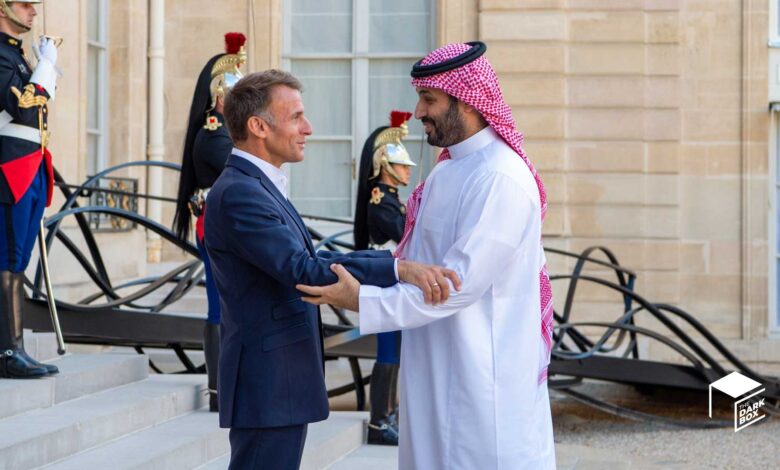
As Paris rolls out a high-level state welcome for Saudi Crown Prince Mohammed bin Salman, the visit is shaping up as far more than another diplomatic meeting between France and Saudi Arabia. It comes at a moment when Riyadh is attempting to consolidate its position as an independent regional power, while competition with the United Arab Emirates increasingly stretches from Yemen and energy markets to Western capitals and the battle for political influence.
For Dark Box, this makes Paris a particularly important arena.
The Crown Prince’s August 23–24 state visit comes at the invitation of French President Emmanuel Macron. The Élysée says the two leaders will preside over the first meeting of the Saudi-French Strategic Partnership Council, while numerous economic agreements are expected across sectors including energy, transportation and health. Regional security, the Middle East conflict and maritime navigation are also on the agenda. French government material describes Saudi-French ties as a strategic relationship that Paris and Riyadh have deliberately worked to deepen.
Against this backdrop, Dark Box is examining claims that Emirati-linked influence networks in France are seeking to shape the political and media environment surrounding Saudi Arabia and its expanding relationship with Paris.
There is an important evidentiary distinction: publicly available information reviewed for this report confirms the depth of both French-Saudi and French-Emirati relations, but it does not independently establish that the UAE government has ordered a coordinated lobbying campaign specifically to sabotage Mohammed bin Salman’s current visit. Such a claim would require documentary evidence, lobbying records, communications or attributable sources with direct knowledge of the effort.
That distinction does not make the underlying strategic competition any less significant.
Mohammed bin Salman Arrives in a France Looking Toward Riyadh
The scale of the reception illustrates how far Saudi-French relations have developed.
Mohammed bin Salman arrived for a state visit on August 23, following a formal invitation from Macron. The visit is expected to produce a substantial package of agreements, while the two leaders will oversee the Strategic Partnership Council created following Macron’s 2024 state visit to Saudi Arabia.
France’s foreign ministry describes the relationship as strategic, spanning political dialogue, investment and broader economic cooperation. Macron and Mohammed bin Salman have also remained in regular contact over regional crises; they spoke as recently as August 7 about security, stability and freedom of maritime navigation.
The significance for Gulf politics is obvious.
Paris is not merely receiving another wealthy Gulf investor. It is institutionalizing a relationship with Saudi Arabia at a moment when Riyadh is asserting greater autonomy over regional security, diplomacy, investment and defense.
For Abu Dhabi, whose own relationship with France is exceptionally deep, the emergence of an increasingly powerful Saudi-French axis introduces another layer of competition.
France Is Also One of Abu Dhabi’s Most Important Western Partners
The UAE possesses formidable influence of its own in France.
According to the French foreign ministry, Paris and Abu Dhabi maintain cooperation covering defense, security, renewable energy, artificial intelligence, universities, space, food security and technology. France also maintains permanently stationed military forces in Abu Dhabi, while an annual strategic dialogue established in 2012 coordinates major bilateral projects.
This is what makes France an unusually sensitive arena for Saudi-Emirati competition.
Both Gulf states possess money, investment relationships, diplomatic access and extensive commercial interests.
Both want to be regarded as indispensable partners for Europe.
But they increasingly offer competing visions of regional order.
The question for Dark Box is whether the UAE’s established networks of access in Paris are being used not merely to advance Emirati interests, but to contain Saudi Arabia’s expanding influence.
A Narrative Battle Around the Saudi Visit
The political environment surrounding Mohammed bin Salman’s arrival illustrates how easily foreign-policy competition can migrate into domestic European debate.
Several French journalists’ unions publicly condemned the Crown Prince’s visit, calling Macron’s invitation a “provocation” for defenders of press freedom.
Such criticism cannot simply be attributed to Abu Dhabi. French civil-society organizations, journalists, politicians and human-rights groups have their own independent positions on Saudi Arabia.
Conflating genuine domestic criticism with foreign lobbying would therefore be analytically irresponsible.
The investigative question is narrower: are Emirati-linked networks attempting to amplify, direct or strategically exploit existing criticism of Riyadh inside France?
That is where any serious investigation must follow the money and institutional relationships.
Which public-relations firms represent Emirati interests? Which think tanks receive Emirati funding? Which political consultants maintain relationships with Abu Dhabi? Which media campaigns intensify around strategically important Saudi diplomatic events? And are apparently independent narratives being coordinated or financed by actors ultimately connected to Emirati interests?
Without answers to those questions, influence cannot responsibly be presented as command-and-control.
The Larger Saudi-UAE Contest
The potential motive must also be understood within the deterioration of Saudi-Emirati relations.
Riyadh and Abu Dhabi increasingly diverge over regional security architecture, Yemen, energy strategy and relationships with other Middle Eastern powers.
The competition is therefore no longer confined to the Gulf.
Each state needs Washington, London, Paris and other major capitals to understand the region through a framework favorable to its interests.
France matters enormously because it is simultaneously a major defense actor, permanent member of the UN Security Council, nuclear power and significant investor in the Gulf.
Influencing how Paris understands the rivalry can therefore produce tangible strategic advantages.
A France that regards Riyadh as its principal Arab strategic partner strengthens Saudi leverage.
A France that remains structurally closer to Abu Dhabi limits it.
Why the Visit Matters to Abu Dhabi
Mohammed bin Salman’s visit threatens to alter that equation precisely because it is institutional rather than ceremonial.
The first meeting of the Strategic Partnership Council is designed to create durable mechanisms connecting Saudi and French decision-making. The expected agreements expand economic interdependence. Discussions on energy and regional security move Riyadh further into areas where Abu Dhabi has spent years cultivating privileged access.
France itself describes Saudi Arabia as a strategic partner, while the Élysée has emphasized the vitality of the bilateral dialogue.
From a competitive Emirati perspective, the danger would not be one successful Saudi visit.
It would be the institutionalization of Saudi influence in Paris.
Conclusion: Paris Becomes Another Front in the Gulf Power Struggle
Mohammed bin Salman’s state visit demonstrates that Saudi Arabia is gaining strategic depth in one of Abu Dhabi’s most important European relationships.
Macron is receiving the Saudi Crown Prince at the highest level. A new institutional framework is being activated. Major agreements are expected. Energy, investment, defense and regional security are all being placed inside a deeper Saudi-French partnership.
For Abu Dhabi, the stakes are substantial.
The UAE spent years constructing exceptional political, military, commercial and technological relationships in France. Saudi Arabia is now building its own increasingly institutionalized partnership with Paris.
The emerging battle, therefore, is not simply over who receives the warmer welcome at the Élysée. It is over which Gulf capital will possess greater influence when France makes decisions about Middle Eastern security, defense, investment and regional power.
If evidence demonstrates that Emirati-linked lobbying networks are actively attempting to incite French political circles against Riyadh during Mohammed bin Salman’s visit, it would mark another escalation in the Saudi-UAE rivalry: a Gulf power struggle exported directly into the political institutions and information environment of Europe.
Until that evidence is produced, that remains the central investigative hypothesis—not an established fact.