The Mecca Pact Shakes the UAE-Israel Axis as a New Battle for the Middle East Takes Shape
Dark Box Investigation
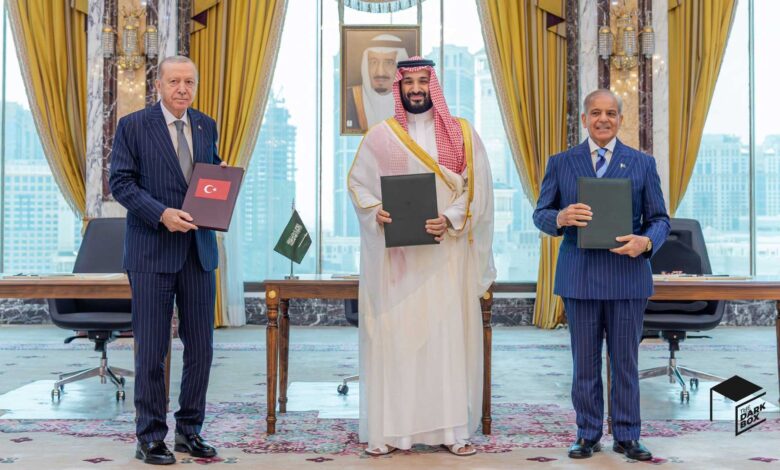
The signing of the Mecca Joint Defence Agreement between Saudi Arabia, Turkey and Pakistan has triggered more than a diplomatic disagreement inside the Gulf. It has exposed a widening contest over who will shape the Middle East’s emerging security order and, according to the material reviewed by Dark Box, placed the UAE-Israel strategic partnership before its most significant regional counterweight yet.
The agreement, signed in Mecca on August 7, commits its three founding states to a collective-defense framework. But its importance extends beyond its formal military provisions. The source material portrays it as Saudi Arabia’s attempt to reclaim strategic autonomy after years in which regional security remained heavily dependent on Washington, while Israel and the UAE developed an increasingly close military and intelligence partnership.
For Abu Dhabi, the challenge is particularly acute. The new arrangement combines Saudi political and financial weight, Turkey’s expanding defense industry and military capabilities, and Pakistan’s large armed forces and nuclear status. More importantly, unlike the UAE-Israel partnership, the Mecca framework potentially possesses something military technology alone cannot manufacture: the political legitimacy to attract additional Arab and Muslim states.
Dark Box’s investigation finds that this is the real fault line emerging from Mecca.
A Deal Abu Dhabi and Israel Did Not See Coming
One of the most striking claims in the source material concerns the circumstances preceding the announcement.
According to the report, the Mecca agreement surprised both Emirati and Israeli intelligence services. It claims Abu Dhabi became aware of the agreement only approximately two weeks before its public announcement, by which point the process was too advanced to stop.
Turkey’s interest in developing a broader Muslim security framework was hardly secret. Turkish Foreign Minister Hakan Fidan had previously advocated greater regional coordination. What appears to have been less predictable was Saudi Crown Prince Mohammed bin Salman’s willingness to institutionalize cooperation with Ankara and Islamabad.
That matters because Riyadh has traditionally occupied the center of the Gulf security architecture.
A Saudi decision to build a major defense mechanism beyond the Gulf Cooperation Council therefore inevitably affects Abu Dhabi’s strategic calculations.
The first battle after Mecca has consequently been over interpretation: Is this simply another Saudi defense agreement, or the beginning of a rival regional order?
Two Competing Security Models
Dark Box identifies two increasingly visible models.
The first revolves around the UAE-Israel relationship.
Normalization under the Abraham Accords brought into public view a relationship that had developed discreetly for years. According to the source report, the war involving Iran accelerated its military dimension considerably, including Israeli deployment of sophisticated defensive capabilities to the UAE. The article cites the Iron Dome system, Iron Beam laser technology and Spectro electro-optical drone-detection capabilities among systems deployed during the conflict.
This is an agile model built around intelligence, advanced technology, interoperable weapons and close relationships with Washington.
The Mecca framework represents something different.
Saudi Arabia contributes enormous financial and political influence. Turkey brings one of NATO’s largest militaries and an increasingly independent defense-industrial base. Pakistan contributes a large military establishment, extensive defense production and nuclear deterrence.
The source describes the emerging competition in terms of agility versus strategic depth. The UAE-Israel relationship can currently coordinate faster and possesses more mature technological interoperability. The Saudi-Turkish-Pakistani structure, however, potentially possesses greater demographic, geographical and political depth.
That distinction explains why the consequences of Mecca cannot be measured simply by counting aircraft, missiles or defense contracts.
Why the UAE Reaction Matters
The clearest public evidence of Emirati unease identified in the source material has emerged through political commentary.
Emirati political scientist Abdulkhaleq Abdullah publicly questioned whether the agreement undermined Gulf cooperation and asked whether other GCC governments had known about it beforehand.
His intervention prompted a pointed Saudi response.
Saudi Prince Abdulrahman bin Musaed publicly defended Riyadh’s sovereign right to enter agreements serving its national interests, questioning why such a principle should become controversial specifically when exercised by Saudi Arabia. Other Saudi commentators interpreted Emirati criticism even more sharply, presenting Mecca as evidence that Riyadh was refusing to remain merely the financial engine behind other states’ regional ambitions.
The significance is not that individual commentators necessarily speak officially for either government. Rather, the exchange offers a visible window into a strategic argument that has become increasingly difficult to conceal.
The dispute asks a fundamental question:
Should Gulf security continue to revolve around the traditional GCC structure, increasingly complicated by Abu Dhabi’s independent partnerships, or can Riyadh construct a wider security architecture on its own terms?
The Netanyahu-MBZ Factor
Behind the disagreement sits the increasingly consequential relationship between UAE President Mohammed bin Zayed and Israel.
The source material portrays the UAE-Israel partnership not merely as diplomatic normalization but as part of a larger strategic network extending into the Red Sea, Horn of Africa and Indian Ocean.
It argues that Israeli and Emirati interests have increasingly intersected around military access, maritime routes and strategic positions, including Somaliland. It further alleges overlapping interests in conflicts including Yemen, Sudan and Libya. These are the source author’s arguments and should not be treated as independently established by the attached material alone.
The broader strategic concept described in the article is nevertheless important.
A regional network connecting Israel with the UAE and partners stretching toward India and the eastern Mediterranean could combine maritime infrastructure, technology, intelligence, capital and military capabilities.
In that architecture, Abu Dhabi would enjoy influence disproportionate to its population because of its capital, ports, technology partnerships and geographical position.
Mecca introduces a rival center of gravity.
Saudi Arabia Reclaims Strategic Autonomy
The agreement also needs to be understood against changing Saudi perceptions of Washington.
The source argues that the wars involving Gaza, Lebanon and Iran have deeply affected Saudi strategic thinking. It quotes former Saudi Shura Council member Ahmed Altuwaijri describing the Mecca agreement as arriving at a critical moment and predicting that additional Arab and Muslim states could eventually join similar arrangements.
Saudi Arabia’s calculation, under this interpretation, is not simply anti-Israeli or anti-Emirati.
It is about reducing dependency.
Riyadh has watched the limitations of American security guarantees while simultaneously observing Washington’s extraordinary military commitment to Israel. A Saudi leadership seeking greater autonomy would therefore have an incentive to diversify its security relationships.
Turkey and Pakistan provide obvious ingredients.
Ankara offers military technology, drones, missiles, warships and operational experience. Islamabad offers military manpower, longstanding defense ties with Saudi Arabia and a nuclear dimension unavailable elsewhere in the Muslim world.
For Riyadh, Mecca potentially provides leverage even if it never develops into a NATO-style alliance.
The Egypt Question Exposes the Trust Problem
Egypt’s possible participation further demonstrates the political sensitivities surrounding the agreement.
The attached source says Turkey favors Egyptian participation and cites Fidan as expressing hope that Cairo could eventually become an official partner. But it also reports Saudi and Pakistani concerns about including Egypt, including fears that sensitive military information could reach Israel or the United States and doubts about what additional operational capabilities Cairo would contribute.
These claims are significant but remain attributed claims within the source material rather than independently demonstrated facts.
They nevertheless illustrate something fundamental about the emerging architecture: membership is ultimately a question of strategic trust, not symbolism.
If the pact expands, decisions about Egypt and other prospective members will reveal whether Mecca becomes a loose diplomatic forum or an integrated security structure.
Yemen and Sudan Could Become Testing Grounds
The most dangerous implication concerns proxy competition.
The report cites an unnamed analyst predicting that deterioration in Saudi-UAE relations could intensify competition in Yemen and Sudan, with Abu Dhabi allegedly seeking to complicate Saudi objectives there.
This prediction should be treated as analysis, not evidence that such sabotage has occurred.
But the underlying danger is credible within the logic described by the source: when neighboring states construct competing security architectures, countries where their interests already diverge become natural arenas for pressure.
Yemen is particularly sensitive because Saudi Arabia and the UAE, despite entering the war as partners, subsequently developed sharply different relationships with local actors.
Sudan represents another arena where their strategic calculations have increasingly diverged.
If Mecca institutionalizes the Saudi-Emirati rivalry rather than merely reflecting it, these conflicts could become laboratories for that competition.
The UAE-Israel Axis Has Technology. Mecca Has Potential Reach.
Dark Box assesses the most important distinction as one of capability versus expandability.
The UAE-Israel partnership possesses substantial immediate advantages. Israel has an advanced defense-industrial base, sophisticated intelligence capabilities and extensive military experience. The UAE possesses enormous capital, advanced Western weapons and an increasingly ambitious regional network.
The Mecca states are considerably less integrated.
Their threat perceptions differ. Their weapons ecosystems differ. Turkey remains embedded in NATO, Pakistan relies heavily on Chinese military technology, and Saudi Arabia remains overwhelmingly dependent on American weapons.
Turning three militaries into an interoperable collective-defense mechanism will therefore require years of exercises, intelligence protocols, communications integration, procurement coordination and political compromise.
But Mecca possesses another asset.
It can potentially expand.
Saudi Arabia’s religious position, Turkey’s regional influence and Pakistan’s standing as the Muslim world’s only declared nuclear-armed state provide the framework with a political constituency that the UAE-Israel partnership cannot easily replicate.
That may explain why an agreement whose military mechanisms remain embryonic has already generated such intense debate.
Dark Box Conclusion: Mecca Is About Who Writes the Next Regional Order
The real significance of the Mecca Joint Defence Agreement is not what its three members can deploy tomorrow morning.
It is what the agreement could become.
For years, Abu Dhabi pursued a highly autonomous foreign policy, constructing relationships with Israel and other international powers while projecting influence through ports, investments, military partnerships and regional allies. Israel simultaneously sought deeper integration into a regional security architecture supported by American military power.
The Mecca agreement challenges the assumption that this trajectory will remain uncontested.
Saudi Arabia is signaling that it can construct partnerships beyond the GCC. Turkey is seeking a larger role in the security architecture of the Arab world. Pakistan brings military weight and strategic deterrence. And if additional states eventually join, the result could be an institutional center of power outside the UAE-Israel framework.
That does not mean the Mecca agreement has already defeated or displaced the UAE-Israel partnership. Its operational provisions remain uncertain, its members have different strategic priorities, and converting political declarations into collective military capability will be difficult.
But Abu Dhabi now faces something it has spent years trying to avoid: a major regional security project whose rules it did not write, whose formation it did not control, and whose center of gravity lies outside the UAE.
For Dark Box, this is why Mecca matters.
The emerging confrontation is larger than Mohammed bin Salman versus Mohammed bin Zayed, or Riyadh versus Abu Dhabi. It is a struggle over the architecture that will replace an increasingly unstable regional order: whether Middle Eastern security will be organized around a technologically sophisticated UAE-Israel partnership anchored to Western power, or around a broader Saudi-Turkish-Pakistani framework capable of attracting additional regional states.
The Mecca pact remains an experiment.
But the intensity of the reaction surrounding it suggests that its competitors understand the stakes very clearlyD.