How UAE Support for Haftar Risks Undermining Efforts to Reunify Libya’s Institutions
Dark Box Investigation
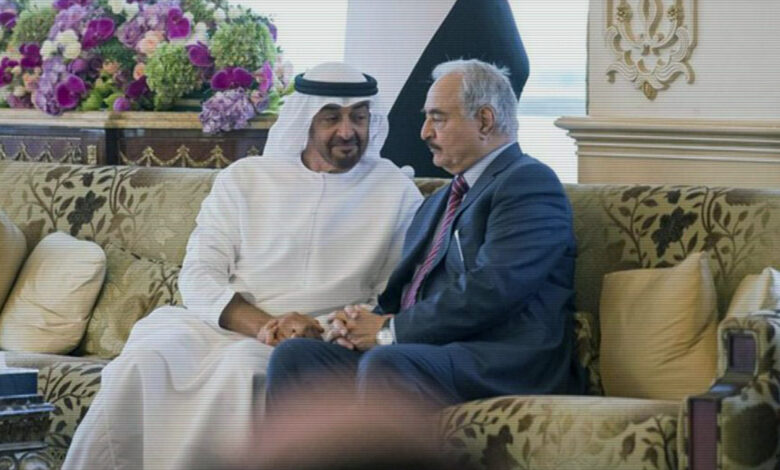
Efforts to reunify Libya’s divided political, military and economic institutions are facing growing resistance, as competing foreign-backed power centres seek to preserve their influence over the country’s future.
At the centre of this struggle is the United Arab Emirates, whose long-standing relationship with Field Marshal Khalifa Haftar has helped consolidate a parallel political and military structure in eastern Libya.
While Abu Dhabi publicly supports stability, dialogue and a UN-led political process, its continued backing for Haftar and his family raises serious questions about whether Emirati policy is compatible with the creation of genuinely unified, civilian and accountable Libyan institutions.
The latest controversy surrounds international initiatives intended to bring Libya’s rival eastern and western authorities under a common political framework.
Libya has remained divided since 2014. Haftar and his allies control the east, while the UN-recognised government led by Prime Minister Abdul Hamid Dbeibah governs from Tripoli in the west. Although large-scale warfare has largely subsided since the 2020 ceasefire, the country still has rival governments, competing military commands and fragmented sovereign institutions.
US envoy Massad Boulos has promoted what he describes as an initiative to unify Libya’s institutions. However, the plan has generated mounting suspicion among Libyan political factions, military forces and protesters.
The most controversial reported element is a proposal that could place Saddam Haftar, one of Khalifa Haftar’s sons and his likely successor, at the head of the Presidential Council.
The council is intended to function as Libya’s highest collective executive authority. Giving its leadership to a member of the Haftar family would therefore grant national legitimacy to a faction that already dominates eastern Libya through military power.
At the same time, reports indicate that Dbeibah could remain prime minister in Tripoli. Such an arrangement would effectively preserve the two most powerful ruling families while reorganising their authority under a nominally unified structure. Critics fear it would not end Libya’s division but formalise it through a political bargain between entrenched elites.
The Emirati connection
The uploaded source does not directly establish that the UAE designed or controls the American initiative. Nevertheless, the proposed elevation of Saddam Haftar would clearly benefit Abu Dhabi’s closest Libyan partners.
For years, the UAE has been one of Haftar’s most important external supporters.
International reporting and conflict assessments have repeatedly identified the UAE, alongside Egypt and Russia, as a major foreign backer of Haftar’s forces. The Emirati relationship with Haftar has been driven partly by Abu Dhabi’s opposition to political Islamist movements and its preference for highly centralised, security-led governments.
During Haftar’s failed 2019–2020 offensive against Tripoli, foreign assistance strengthened his ability to challenge the internationally recognised government militarily. Human Rights Watch documented abuses by forces associated with both sides of the conflict and identified the UAE among the foreign states supporting Haftar.
This history matters because the institutions now being discussed for reunification are not politically neutral.
Haftar’s military organisation has evolved into an extensive system of territorial control, patronage, commercial interests and family authority. His sons hold increasingly powerful military, political and economic positions, creating what critics describe as a developing hereditary power structure.
Recent reporting indicates that the Haftar family controls crucial military formations, territory, oil infrastructure and political decision-making in the east. External support from countries including the UAE has helped sustain this model.
Under these conditions, placing Saddam Haftar at the head of a unified Presidential Council could transform military power acquired through conflict into internationally recognised state authority.
For the UAE, such an outcome would preserve its influence regardless of whether Libya formally reunifies.
Unification or redistribution of power?
The central question is whether current diplomatic initiatives are intended to reunify Libya’s institutions or merely redistribute senior positions between the country’s dominant factions.
A genuine institutional reunification process would require a single civilian government, an agreed constitutional framework, transparent management of oil revenues, accountable security forces and a credible path to national elections.
By contrast, a deal that retains Dbeibah in the west while elevating Saddam Haftar nationally could allow both families to remain in power without obtaining a democratic mandate.
Analyst Jalel Harchaoui told Middle East Eye that such an arrangement could provide both Saddam Haftar and Dbeibah with national legitimacy and allow them to remain in office for at least another year, and potentially much longer.
This possibility has provoked strong resistance in Misrata, a major commercial and military centre whose forces played a crucial role in resisting Haftar’s assault on western Libya.
Protesters confronted Boulos during his July visit and denounced what they described as a “suspicious deal”. Leaders in Misrata argue that the Haftar family should not be rewarded with sovereign positions after its military campaign against Tripoli and the serious abuses attributed to forces aligned with it.
Opposition has also emerged from armed groups and political actors outside both the Haftar and Dbeibah camps. Their concern is that an externally negotiated agreement could exclude independent forces while granting permanent legitimacy to the two families that currently dominate Libya’s divided system.
Why prolonged division serves outside influence
Libya’s institutional fragmentation has created significant opportunities for foreign powers.
Separate authorities in the east and west depend on different external sponsors for military, diplomatic and economic support. This dependence gives outside governments leverage over Libyan decision-making.
For the UAE, its relationship with Haftar provides strategic access to eastern Libya, influence over an important North African state and a partner aligned with Abu Dhabi’s regional opposition to political Islam.
The continuation of a semi-autonomous eastern military structure also ensures that any national government must negotiate with Haftar rather than exercising undisputed authority over the entire country.
This creates a contradiction in the UAE’s stated position.
Abu Dhabi can formally endorse Libyan unity while supporting a power structure whose survival depends on maintaining an independent military and political centre in the east.
The result is not necessarily open opposition to reunification. It is a narrower form of unity designed around the preservation of Haftar’s influence.
From this perspective, the danger is that reunification becomes an administrative label rather than a genuine transfer of power to national institutions.
A Presidential Council headed by Saddam Haftar could appear unified internationally while leaving the Haftar family’s command structures, armed formations and economic networks largely intact.
Oil, security and the marginalisation of elections
Foreign interest in Libya is also shaped by oil, migration, military access and competition with Russia.
Libya holds Africa’s largest proven oil reserves, and Washington has encouraged American companies to participate in new licensing opportunities. The United States is also seeking closer coordination between eastern and western Libyan military units, partly to limit Russia’s access to bases and ports controlled by Haftar’s forces.
These priorities may explain why international actors are concentrating on agreements between powerful elites rather than insisting first on elections.
The UN continues to identify national elections and a unified government as central objectives. Yet Libya’s political process remains stalled, and competing authorities continue to dispute the legal and constitutional framework required for voting.
Elections have also been largely absent from the publicly described elements of the Boulos initiative.
Boulos has argued that institutional unity must precede democratic elections. Critics, however, fear that postponing elections until after an elite agreement would give the new leadership the power to delay voting indefinitely.
This concern is particularly serious when the proposed beneficiaries are figures who already possess armed forces, financial networks and foreign backing.
A policy that risks entrenching division
There is no publicly available evidence proving that the UAE is single-handedly directing efforts to derail Libya’s reunification.
Nor does the uploaded report establish that Abu Dhabi created the Boulos initiative or dictated its proposed appointments.
However, the political outcome under discussion would reinforce the position of the Haftar family, which has benefited from years of Emirati military and political support.
That creates a legitimate basis for scrutinising the UAE’s role.
If Abu Dhabi continues to support a family-controlled military structure while endorsing a political agreement that grants that family national authority, its policy may contribute to the institutionalisation of Libya’s division rather than its resolution.
Libya could emerge with formally unified bodies but without unified command, democratic legitimacy or civilian control.
Such an arrangement would preserve the appearance of national reconciliation while allowing rival elites and their foreign sponsors to maintain their influence.
Conclusion
The struggle over Libya’s reunification is no longer simply a conflict between east and west.
It is a contest over whether national institutions will be rebuilt through elections, constitutional rules and public accountability—or divided among powerful families supported by foreign governments.
The UAE’s long relationship with Khalifa Haftar places Abu Dhabi at the heart of this question.
By strengthening Haftar’s military organisation and maintaining close ties with his emerging family dynasty, Emirati policy has helped create a powerful eastern structure that cannot easily be absorbed into a unified civilian state.
Any initiative that elevates Saddam Haftar without dismantling parallel military authority risks rewarding the very system that has sustained Libya’s fragmentation.
The greatest danger is therefore not that reunification will fail publicly.
It is that Libya will be declared unified while its institutions remain controlled by rival elites, armed families and foreign interests—leaving Libyans with a new political arrangement but no genuine national state.