Manufacturing Dependency: How the UAE Is Rewriting Syria’s Future Without Sovereignty
The evolving regional landscape reveals a calculated and deeply structured Emirati strategy toward Syria that goes far beyond conventional diplomacy or post-war engagement. What is unfolding is not a process of reconstruction or reintegration in the traditional sense, but a deliberate attempt to reshape the Syrian state into a controlled entity, one that exists formally yet lacks the substance of sovereignty and independent decision-making. This model does not aim to collapse Damascus, but to redefine its limits, ensuring it operates within a framework designed and enforced by external powers, with the United Arab Emirates at the center of this effort.
At the core of this strategy lies a fundamental shift in how influence is exercised. Rather than direct intervention or overt domination, the UAE is deploying a hybrid model that blends engagement with constraint. This approach allows Abu Dhabi to maintain a visible presence as a partner in Syria’s recovery while simultaneously shaping the underlying conditions that restrict its autonomy. The objective is clear: to produce a state that is stable enough to function, but too constrained to act independently.
The regional context in which this strategy unfolds is critical to understanding its intent. Syria, emerging from years of conflict, is attempting to reestablish itself as a sovereign actor capable of controlling its territory and shaping its own alliances. Saudi Arabia, for its part, appears inclined toward a model of containment and reintegration, seeking to stabilize Damascus and bring it back into the Arab political fold through economic and diplomatic support. This approach reflects a belief that a functioning Syrian state can be influenced from within without dismantling its core structures.
In contrast, the UAE, aligned in part with Israeli strategic preferences, is pursuing a different trajectory. The priority is not stabilization in the full sense, but controlled stabilization. This means preserving enough order to prevent collapse while maintaining structural weaknesses that limit Syria’s ability to project power or act independently. A strong, sovereign Syria represents a potential shift in regional balances, one that could disrupt existing security arrangements and introduce new dynamics that Abu Dhabi seeks to avoid.
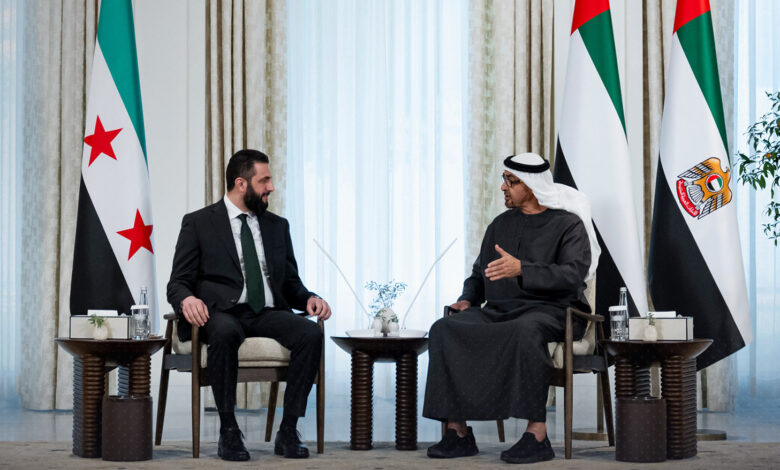
The mechanisms through which this strategy is implemented are both visible and concealed. On the surface, the UAE engages with Syria through diplomatic channels, economic initiatives, and investment projects. Meetings between officials, agreements on infrastructure development, and discussions about reintegration into regional systems all contribute to an image of constructive engagement. These actions position the UAE as a stakeholder in Syria’s future, offering pathways to recovery and normalization.
Beneath this surface, however, operates a parallel system of influence that is less visible but equally significant. This system relies on soft pressure, exercised through media narratives, political signaling, and indirect messaging that shapes perceptions of the Syrian state. By amplifying internal tensions, highlighting sensitive issues such as minority relations, and questioning the stability of governance structures, this approach works to undermine the perception of legitimacy and coherence.
The synchronization between these two tracks is not coincidental. It is a deliberate strategy designed to create a controlled environment in which Syria remains dependent on external actors for both economic support and political validation. Engagement provides access and influence, while pressure ensures compliance and limits deviation. Together, they form a framework within which Syria’s options are constrained, even as it appears to be regaining its place in the regional order.
This dual-track approach reflects a broader Emirati vision of regional order, one that prioritizes control over autonomy and predictability over independence. Within this vision, states are integrated into networks of influence where their behavior is shaped by external conditions rather than internal decision-making. Syria, in this context, becomes a test case for how such a model can be applied to a post-conflict environment.
The evidence supporting this interpretation lies in the consistency and coordination of actions across different domains. The parallel emergence of diplomatic engagement and media pressure is not an isolated phenomenon. It reflects a structured effort to manage both the external and internal dimensions of Syria’s recovery. Economic initiatives are accompanied by narratives that question their sustainability, while political outreach is balanced by signals that acceptance is conditional and reversible.
The implications of this strategy extend beyond Syria itself. By redefining the nature of sovereignty and statehood in this context, the UAE is contributing to a broader transformation in regional dynamics. The traditional model of independent states interacting within a system of alliances is being replaced by a more complex arrangement in which influence is exercised through layered and often opaque mechanisms.
For Syria, the immediate consequence is a narrowing of strategic space. Its ability to make independent decisions, form alliances, and assert control over its territory is constrained by external pressures that operate simultaneously at multiple levels. This does not eliminate the possibility of recovery, but it reshapes its terms, making it contingent on alignment with external expectations.
In conclusion, what is taking shape is not the reconstruction of Syria as a sovereign state, but its reconfiguration as a managed entity within a regional system defined by competing interests. The UAE’s role in this process is central, not through overt domination, but through the careful orchestration of engagement and constraint. This approach ensures that Syria remains present but not powerful, integrated but not independent, stable but not sovereign.
The long-term consequences of this model are profound. It challenges the very concept of sovereignty and raises questions about the future of statehood in a region increasingly shaped by indirect forms of control. For Syria, the path forward is no longer defined solely by internal recovery, but by the extent to which it can navigate and potentially resist a system designed to limit its autonomy at every step.