From Lavon to Tehran: Is Iran’s Jewish Community Becoming Fuel for a Major Entrapment Operation?
In open wars, missiles are not the only weapons used. There is always another, darker front: the narrative front. On this front, the objective is not just to destroy a military target, but to redefine the enemy itself, morally and politically, before the world.
Intelligence assessments circulating within Israeli security circles point to psychological warfare scenarios under discussion, with particular focus on the issue of Jews inside Iran as a major political and media pressure tool. A major incident targeting the Jewish community, such as a synagogue, a religious institution, or a prominent figure, could completely reshape the war by portraying Iran to the world as a regime driven by existential hostility toward Jews, rather than merely a geopolitical adversary of Israel. Such a shift could create the moral and political justification for expanding the scope of international confrontation against Tehran.
The same intelligence assessments have also outlined potential mechanisms for executing such a scenario through regional networks linked to Israel, including environments where there is an active Jewish presence in the United Arab Emirates. The growing relationship between Tel Aviv and Abu Dhabi in recent years has not been limited to economic and investment cooperation, but has expanded into security and intelligence domains. Within this context, the network of alliances that has taken shape in Abu Dhabi could make such a scenario feasible.
Discussion of this scenario reportedly began about two weeks after the outbreak of the war between Israel and Iran, when strategic assessment circles in Washington and Tel Aviv realized that the assumptions behind the initial strike were flawed. Ongoing discussions within security institutions indicate that the early war plan, based on delivering concentrated strikes aimed at top Iranian leadership in order to destabilize or quickly collapse the system, failed to achieve its intended results. Despite targeted strikes and assassinations against senior figures and command structures, the system in Tehran continues to demonstrate a notable degree of political and security cohesion.
At the same time, another unexpected factor emerged: the absence of direct Western military support for the war. European countries, despite their political backing for Israel, have refrained from engaging militarily in the confrontation. At the regional level, most Gulf states have clearly refused to be drawn into the war, fearing that their territories and oil infrastructure could become targets. The only exception in this context has been the United Arab Emirates, which has taken a position more aligned with the Israeli approach, while the rest of the Gulf capitals have chosen to distance themselves from the escalation.
This reality has created a growing dilemma in Washington and Tel Aviv. According to converging economic and military assessments, the war is increasingly turning into a highly costly war of attrition. The expenses associated with military operations, air defense systems, and interceptor missiles are rising rapidly, placing mounting pressure on both the American and Israeli military budgets and economies. At the same time, Russia and China have fully entered the scene in support of Iran. Under these conditions, it becomes difficult to sustain the war for an extended period without achieving a major political shift or creating a broad moral and political justification that could push Western and regional allies to join the confrontation and force Russia and China to halt their support for Iran.
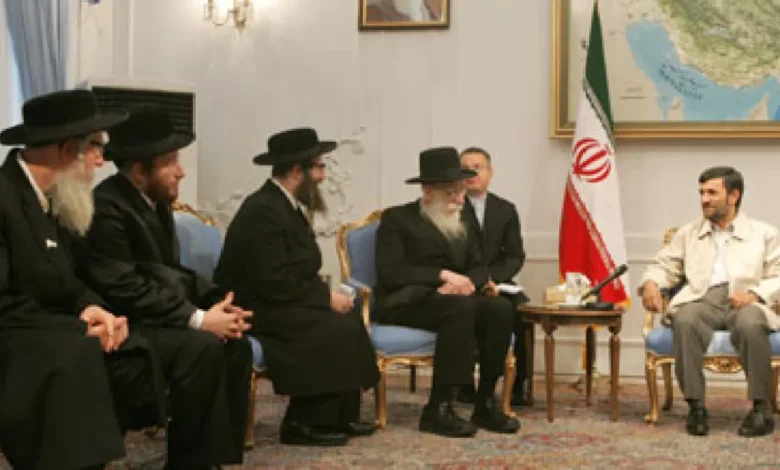
The Jewish community in Iran is small in number but large in symbolic significance, and its position within the Iranian state means that any incident affecting it can quickly become a security, propaganda, and diplomatic issue all at once. Estimates based on Iranian statistics and international reports suggest that their number today ranges between nine and ten thousand people. Despite their relatively small size, the community still maintains a clear institutional presence within the country, giving it a symbolic weight that exceeds its demographic size.
Iranian Jews are primarily concentrated in three major cities: Tehran, Shiraz, and Isfahan. Tehran hosts the largest number of community members and serves as its social and institutional center, where synagogues, schools, and Jewish charitable organizations are located. Shiraz and Isfahan represent a historical extension of Jewish presence in southern and central Iran, where some Jewish families trace their roots back many centuries. This geographic distribution ties the community to cities of political, economic, and historical importance within Iran, which adds an extra layer of sensitivity to any incident involving them during wartime.
Since the beginning of the current war, the Jewish community in Iran has adopted a clear strategy based on maintaining a low profile and avoiding media visibility. This silence is not new but rather a behavior shaped over decades of tension between Iran and Israel. The community understands that any political statement or public appearance could be interpreted within Iran as taking a position in the conflict, potentially exposing it to security or political pressure. As a result, Jewish religious and community leaders inside the country tend to emphasize their Iranian national identity and avoid engaging in political debates related to the war.
Although Jews in Iran play no direct role in the conflict, their presence carries significant symbolic weight in the media and diplomatic arena. They are not a transient community or an isolated group; they are an old part of Iran’s social fabric, with established institutions, schools, synagogues, parliamentary representation, and charitable organizations. The Iranian state often highlights their presence as evidence of a distinction between “Jews” and “Zionism” in its official discourse.
For this very reason, the Jewish community inside Iran becomes an ideal focal point in any scenario aimed at putting pressure on the Iranian system, not militarily, but morally.
In this context, the sensitivity of Isfahan cannot be ignored. It is one of the most prominent traditional centers of the Jewish community and also one of the most strategically important cities in Iran’s nuclear program. The city hosts several critical sites, including the Uranium Conversion Facility in Isfahan, which is a key component of Iran’s nuclear fuel cycle. Any incident there would not be viewed merely as an attack on a religious community, but as a message delivered at the very heart of Iran’s most sensitive strategic geography.
These assessments are not far-fetched. History offers a highly significant precedent: the Lavon Affair, also known as Operation Susannah, in Egypt in the mid-nineteen fifties. At that time, Egyptian Jews were recruited into a covert network to carry out limited bombings targeting civilian sites linked to Western and Jewish interests. The political objective was clear: to create the impression that Egypt was unstable and that local anti-Western groups were responsible, thereby pressuring Britain and the United States to maintain their military presence in the Suez Canal. The operation ultimately failed and was exposed, but it remains in intelligence literature as a classic example of false flag operations and the use of local communities to manufacture a security incident in order to influence major political decisions.
The Lavon Affair is not the only example cited in security literature when discussing the sacrifice of Jewish communities in the context of covert wars. At various stages, the leadership of the Zionist movement, particularly under David Ben Gurion, made decisions that involved risking Jewish communities abroad in pursuit of broader strategic objectives, including encouraging migration and reshaping the political environment in the region.
In the case of Iraqi Jews in the early nineteen fifties, a series of bombings and attacks targeted Jewish sites in Baghdad between nineteen fifty and nineteen fifty one, leading to the migration of around one hundred twenty thousand Iraqi Jews to Israel. It was later revealed that these operations were in fact purely Zionist operations, used to accelerate the exodus toward the newly established state.
Although a significant amount of time has passed between those events and today, the underlying principle remains the same. When the objective is to reshape how the conflict is perceived in the West, a symbolic event can sometimes matter more than a direct military strike. Targeting Jews inside Iran could serve two purposes at once. First, it would undermine the Iranian narrative that its conflict is with Israel, not with Jews. Second, it would provide Israeli and American narratives with powerful moral material to justify expanding the scope of confrontation.
However, the real danger does not lie in repeating a crude version of past operations but in their modern form. Today’s wars do not always require a clear physical footprint. Sometimes an ambiguous incident, a vague attack, or even an information operation built around an unverified claim of an imminent threat can be enough to trigger international pressure. In such an environment, the Jewish community inside Iran could become an easy symbolic lever within escalation narratives, whether through an actual incident or through large-scale disinformation.