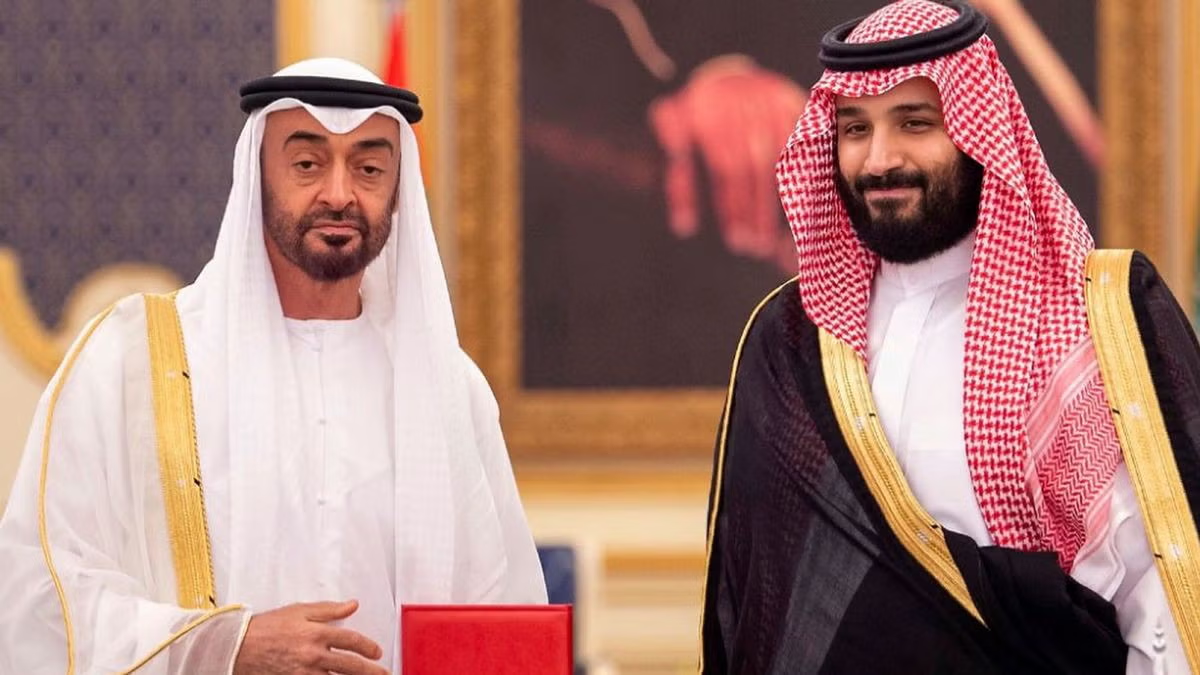
Strategic Shift in the Middle East: Saudi Arabia Leads Stability Axis Against UAE’s Crisis-Driven Agenda

Well-informed sources have confirmed to Dark Box that Saudi Arabia is executing a comprehensive strategy to reshape the Middle East through a model grounded in stability, de escalation, and regional rebalancing, in clear contrast to what sources describe as the crisis driven approach pursued by the UAE and its close alignment with Israel. According to these sources, Riyadh’s current trajectory reflects a calculated shift from reactive diplomacy to proactive regional leadership, aiming to contain conflicts, rebuild state institutions, and prevent further fragmentation across the Arab world.
Sources indicate that the Saudi approach is rooted in a reassessment of regional dynamics following the war in Gaza, which exposed deep structural imbalances in the Middle East. Saudi policymakers concluded that unchecked military escalation and the normalization framework promoted by Israel and supported by the UAE have failed to deliver sustainable peace. Instead, they have intensified public anger, destabilized societies, and eroded trust in regional institutions. This realization has driven Riyadh to adopt a different path, one that prioritizes political solutions, regional dialogue, and economic integration over military alliances and proxy conflicts.
At the core of this strategy is Saudi Arabia’s effort to rebuild a network of balanced regional partnerships. Sources confirm that Riyadh has expanded its coordination with key actors such as Turkey, Qatar, and Egypt, forming a flexible axis aimed at stabilizing conflict zones rather than exploiting them. This alignment is particularly visible in files such as Sudan, the Red Sea, and the Horn of Africa, where Saudi diplomacy has focused on supporting state institutions and limiting the influence of non state armed actors. In parallel, Saudi Arabia has maintained open channels with Iran, recognizing that regional stability cannot be achieved without addressing broader security concerns.
In contrast, sources describe the UAE’s regional conduct as increasingly centered on influence through fragmentation. From Yemen to Sudan and parts of North Africa, Abu Dhabi has been accused of supporting local militias and secessionist movements, seeking to expand its strategic footprint through indirect control rather than state to state cooperation. This approach, according to the same sources, has contributed to prolonged conflicts, weakened central governments, and created environments of chronic instability that undermine long term development.
One of the most significant aspects of Saudi Arabia’s strategy is its repositioning on the question of Israel. Sources confirm that Riyadh has moved away from earlier normalization discussions, particularly after the scale of destruction in Gaza. Saudi leadership now views unconditional alignment with Israel as incompatible with regional stability and public sentiment across the Arab and Islamic worlds. Instead, the kingdom is pursuing a conditional framework that links any future engagement to tangible political progress, particularly regarding Palestinian rights. This shift represents a direct challenge to the UAE’s model, which has prioritized strategic partnership with Israel regardless of regional backlash.
Economically, Saudi Arabia is leveraging its resources to reinforce this new vision. Large scale investments in infrastructure, energy, and connectivity projects are being designed not only for national development but also to create interdependence across the region. By promoting shared economic interests, Riyadh aims to reduce incentives for conflict and encourage cooperative frameworks. Sources highlight that these initiatives are increasingly being coordinated with regional partners, reinforcing Saudi Arabia’s role as a central hub for economic integration.
The information received by Dark Box also points to a growing narrative battle accompanying this strategic shift. Saudi voices, including influential academics and commentators, have begun openly criticizing the UAE’s regional policies and its close alignment with Israel. This discourse reflects a broader transformation within the kingdom, where the perception of threats has evolved from traditional rivals to include destabilizing policies pursued by nominal allies. The fact that such views are being expressed publicly is seen by sources as a signal of official tolerance, if not endorsement, of this new direction.
The outcome of this strategy, according to well informed sources, is already becoming visible. Saudi Arabia is consolidating its position as a stabilizing force, attracting partners who are seeking alternatives to conflict driven policies. At the same time, the UAE is facing increasing resistance in several arenas, as local and regional actors push back against what they perceive as interference and destabilization.
In conclusion, sources emphasize that Saudi Arabia’s plan to reshape the Middle East is not merely a policy adjustment but a structural transformation of regional order. By prioritizing stability, dialogue, and economic integration, Riyadh is attempting to redefine power dynamics in the region. In contrast, the UAE’s approach, characterized by intervention and alliance with controversial external actors, is increasingly viewed as a source of instability. The emerging divide between these two models is set to shape the future of the Middle East, with Saudi Arabia positioning itself as the architect of a more balanced and sustainable regional system.