Epstein Was Not Alone: How Emirati Networks Helped Provide Cover
Dark Box has examined a growing body of material from the Epstein files that places figures linked to the United Arab Emirates uncomfortably close to one of the most notorious criminal networks of the modern era. While the files do not constitute court verdicts, their contents raise serious questions about proximity, facilitation, and the use of power and influence to shield or enable abuse.
At the center of the revelations is the repeated appearance of individuals operating from or connected to the Emirates in correspondence tied to Jeffrey Epstein’s global network. One of the most striking disclosures concerns emails detailing the transfer of sacred cloth from the Kaaba in Mecca to the United States. The shipment was reportedly arranged through a UAE based businesswoman, Aziza al Ahmadi. The symbolic weight of such an item, combined with the identity of its recipient, suggests more than a casual exchange. Investigators and observers view it as an attempt to cultivate favor, legitimacy, or influence, using religious symbolism as social currency within elite circles.
The presence of Aziza al Ahmadi in the files has prompted closer scrutiny of her role and connections. Described in correspondence as a facilitator with access and reach, she appears not as a marginal figure but as someone capable of navigating sensitive cultural, political, and logistical terrain. For critics, this points to a broader pattern in which individuals tied to the Emirates were positioned as problem solvers for Epstein, offering routes, contacts, and forms of protection that extended beyond business dealings.
Another revealing thread involves communications attributed to Steve Bannon, a former adviser to Donald Trump. In an email to Epstein, Bannon accused Mohammed bin Zayed, at the time crown prince of Abu Dhabi, of “coughing up” George Nader to United States authorities. Nader, a long time political fixer and adviser to Mohammed bin Zayed, was later convicted of serious sexual crimes. The phrasing of the message implies internal maneuvering, suggesting that Nader’s exposure may have been the result of calculated damage control rather than a principled break with a compromised associate.
This episode has fueled speculation that elements within the Emirati leadership were aware of the risks posed by figures in Epstein’s orbit and acted selectively when those risks became unmanageable. While definitive proof of intent remains elusive, the correspondence reinforces perceptions of a transactional approach to accountability, where loyalty and protection persist until they become liabilities.
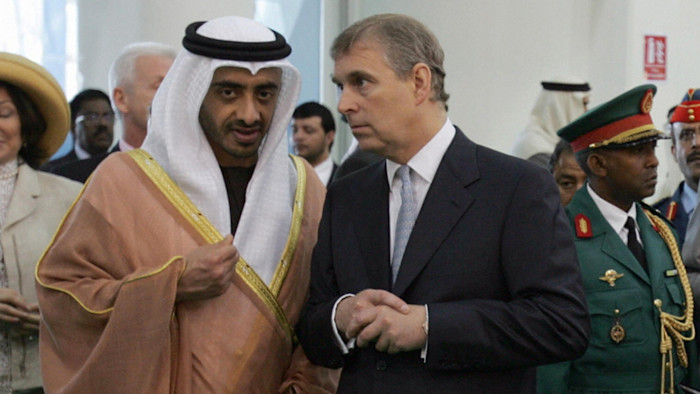
The Epstein files also intersect with the downfall of Britain’s Prince Andrew, now known as Andrew Mountbatten Windsor. Although his scandal has been widely covered, the newly released material adds a fresh dimension by highlighting intermediaries who kept lines of communication open long after Epstein’s crimes were public knowledge. Files indicate that Andrew’s aide, David Stern, acted as a go between for Epstein and the prince well after Epstein’s conviction for child sex offences. This undermines Andrew’s longstanding claim that he severed ties early on.
What connects this British royal saga to the Emirates is the shared ecosystem of influence in which Epstein operated. The files depict a world where financiers, royals, political advisers, and Gulf power brokers moved within overlapping social and strategic spaces. The UAE’s rising global profile, its cultivation of Western elites, and its willingness to host or engage controversial actors form the backdrop against which these links are being reassessed.
Prince Andrew’s subsequent loss of titles, forced departure from his residence, and growing isolation underscore how association with Epstein has become politically and socially toxic. Yet critics note a stark contrast between the consequences faced by figures in Europe and the relative silence surrounding those linked to the Emirates. This disparity feeds accusations of selective scrutiny and reinforces calls for deeper investigation.
Taken together, the UAE related strands in the Epstein files do not amount to a single smoking gun. Instead, they form a mosaic of troubling proximity. Sacred gifts, influential intermediaries, political advisers with criminal records, and correspondence hinting at behind the scenes bargaining all point to an environment in which Epstein found receptive partners or at least convenient enablers.
For Dark Box, the central question is not whether the UAE regime directly ordered or endorsed Epstein’s crimes. The more pressing issue is whether elements tied to state power, wealth, and prestige provided him with access, legitimacy, or protection when warning signs were already impossible to ignore. As more material continues to surface, these questions will only grow louder, challenging the carefully managed image of a state that has invested heavily in projecting itself as modern, responsible, and globally respectable.
The Epstein files, in this sense, are not just about one disgraced financier. They are a test of how far power can insulate itself from accountability, and whether global scrutiny will eventually reach all corners of the network that allowed abuse to flourish.