Dubai’s Financial Mirage Shattered: Dark Box Investigation Into the Collapse of the Emirate’s Global Investment Image After the Iran War
For decades, Dubai cultivated an image as the Middle East’s safest financial gateway, a neutral hub where global capital could flow freely despite regional instability. That reputation is now facing its most serious crisis. According to evidence reviewed by Dark Box, the ongoing war between the United States, Israel, and Iran has struck directly at the foundations of Dubai’s financial model, raising questions about whether the emirate can still function as a global investment center.
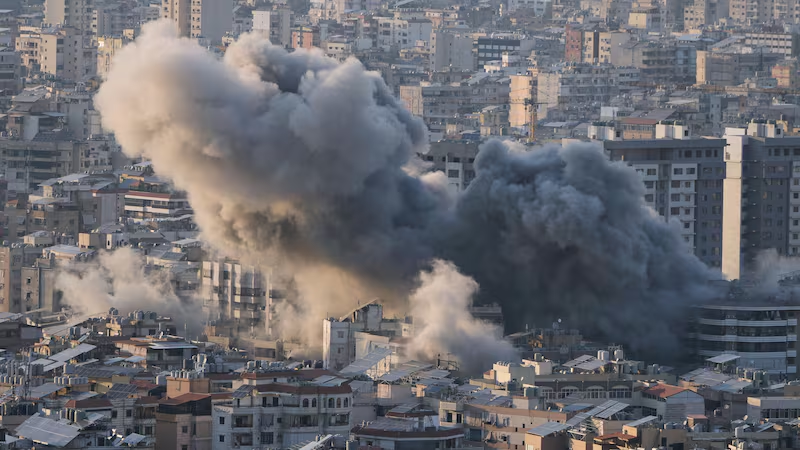
The latest warning sign came from the heart of Dubai’s financial district. Thick smoke was seen rising from the area surrounding the Dubai International Financial Centre after debris from an intercepted Iranian drone caused a fire on the facade of a building in the district. The incident, though officially described by authorities as minor, carried powerful symbolic implications.
The financial district has long served as the headquarters for international banks, law firms, and investment funds operating in the Gulf. Damage occurring within this zone represents more than a physical event. It strikes at the perception of security that underpins Dubai’s entire financial system.
The attack came amid escalating Iranian retaliation following the war launched by United States and Israel against Iran. Iranian officials had already warned that economic and financial centers in the Gulf could become legitimate targets if the conflict expanded.
In response to the rising threat level, several international institutions moved quickly to protect their personnel. Employees at the American financial group Citigroup were instructed to evacuate offices in the financial district and surrounding areas because of security concerns.
Major consulting firms followed similar steps. PwC temporarily closed offices across several Gulf states, including the United Arab Emirates, Saudi Arabia, Qatar, and Kuwait. Deloitte also instructed its staff to leave its premises in Dubai’s financial center as a precaution.
These decisions illustrate a fundamental shift in the way multinational corporations now view the security environment in the region.
For years, Dubai marketed itself as insulated from the geopolitical tensions surrounding it. The city’s strategy relied on projecting stability while positioning itself as a neutral financial gateway between East and West.
However, the current conflict has undermined that narrative. Iran has launched large scale retaliatory attacks across the Gulf, with more than eighteen hundred drones and missiles reportedly directed toward targets in the United Arab Emirates.
Several prominent sites have already been damaged. Among them are major luxury landmarks including the Fairmont hotel on Palm Jumeirah and the iconic Burj Al Arab. Drone activity has also been reported near Dubai International Airport, one of the busiest aviation hubs in the world.
While the physical damage so far has been limited, the psychological effect on investors may prove far more significant.
Dubai’s economic model depends heavily on global confidence. Banks, hedge funds, and multinational corporations base regional headquarters in the city because they believe their operations will remain protected from regional conflict.
Once that perception is broken, rebuilding it becomes extremely difficult.
Another critical factor is the disruption to global energy routes. Iran’s decision to close the Strait of Hormuz has sent shockwaves through international markets. The strait normally carries a substantial share of global oil and liquefied natural gas exports.
The closure threatens shipping flows, increases insurance costs for cargo vessels, and undermines the logistics networks that support Gulf economies.
For Dubai, which relies heavily on trade, logistics, and financial services linked to maritime commerce, these developments represent a severe structural risk.
Casualties have also begun to mount. At least several civilians in the UAE have reportedly been killed since the conflict began, including migrant workers from South Asia. These deaths highlight how quickly regional instability can translate into human and economic losses.
Financial analysts interviewed by Dark Box say the greatest danger now lies in capital flight.
If investors begin to believe that Dubai is no longer a safe financial haven, money could move rapidly toward alternative centers in Asia and Europe.
The implications would extend far beyond the local economy. Dubai hosts regional operations for hundreds of multinational corporations and manages billions of dollars in cross border financial flows.
A sustained loss of confidence could therefore weaken the emirate’s position within the global financial system.
In previous crises, Dubai was able to rely on the perception that geopolitical shocks would remain contained outside its borders.
The current war has shattered that assumption.
The Dark Box investigation concludes that the conflict between the United States, Israel, and Iran has revealed a structural vulnerability in Dubai’s economic model. By aligning itself with one side of a regional war, the emirate has exposed the very financial infrastructure that once made it attractive to global investors.
As the conflict continues, the question facing financial markets is no longer whether Dubai can withstand temporary disruptions.
It is whether the city can still claim the role it once held as the Middle East’s safest and most reliable financial hub.