Dubai in Freefall: Dark Box Investigation Into Property Panic and Capital Flight After Iran Strikes
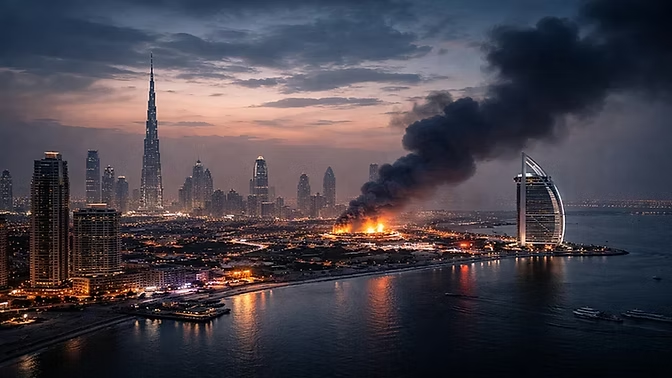
The real estate market in Dubai, long considered one of the most resilient and attractive investment destinations globally, is now showing clear signs of stress as geopolitical shocks ripple through the Gulf. According to a Dark Box analysis of recent financial data, market activity, and investor behavior, the combination of Iranian strikes, regional instability, and economic disruption has triggered early stages of what could become a broader correction in property prices across Dubai and Abu Dhabi.
Recent data indicates that transaction volumes in Dubai’s property sector have dropped sharply, with deals declining significantly both year on year and month on month. Sellers are increasingly offering discounts, in some cases reaching double digit reductions even in premium locations such as areas near Burj Khalifa and Palm Jumeirah.
This is not an isolated fluctuation but part of a wider shift in sentiment. Analysts now warn that in a bearish scenario, property prices could decline steadily in the coming period, reflecting weakening demand and reduced population growth driven by geopolitical uncertainty.
At the same time, financial markets are signaling deeper concern. Major real estate developers have seen their valuations fall sharply, with leading companies losing a significant portion of their market value since the outbreak of the conflict.
Collapse of Confidence: The Core Driver
The most critical factor behind the property slowdown is not purely economic, but psychological. Dubai’s entire real estate model depends heavily on foreign investors who view the city as a safe haven for capital.
That perception has been severely damaged.
Iranian missile and drone strikes targeting the UAE have shattered the image of Dubai as insulated from regional conflicts. Hundreds of projectiles have been launched toward the country, with damage reported in key areas including near luxury developments, airports, and financial zones.
Even when most attacks are intercepted, falling debris and repeated alerts have created a climate of uncertainty. Airspace closures, explosions over the city, and visible damage to infrastructure have all contributed to a growing sense of insecurity.
This shift in perception is critical. In real estate markets driven by international capital, fear spreads faster than any physical damage.
Panic Selling and Market Behavior
Evidence of panic is emerging at multiple levels of the market.
Property brokers report that buyers are delaying decisions, canceling deals, and adopting a wait and see approach. Transactions are slowing, site visits are declining, and speculative buying is fading.
At the same time, anecdotal and online listings increasingly show distressed sales, with properties being offered at reduced prices in order to secure quick liquidity. The phenomenon often described informally as panic selling is becoming more visible, particularly among investors who entered the market during the recent boom and are now seeking to exit before conditions worsen.
This behavior reflects structural vulnerabilities in Dubai’s property model. A large portion of the market is based on off plan investments and short term speculative flipping. When confidence weakens, this segment becomes the first to react.
Broader Economic Shock
The property slowdown cannot be separated from wider economic disruption.
Tourism, a key pillar of Dubai’s economy, has been severely affected. Reports describe major areas of the city becoming unusually quiet, with hotels, beaches, and commercial districts experiencing sharp declines in activity.
Hotels have already begun cutting prices to attract customers, signaling falling demand.
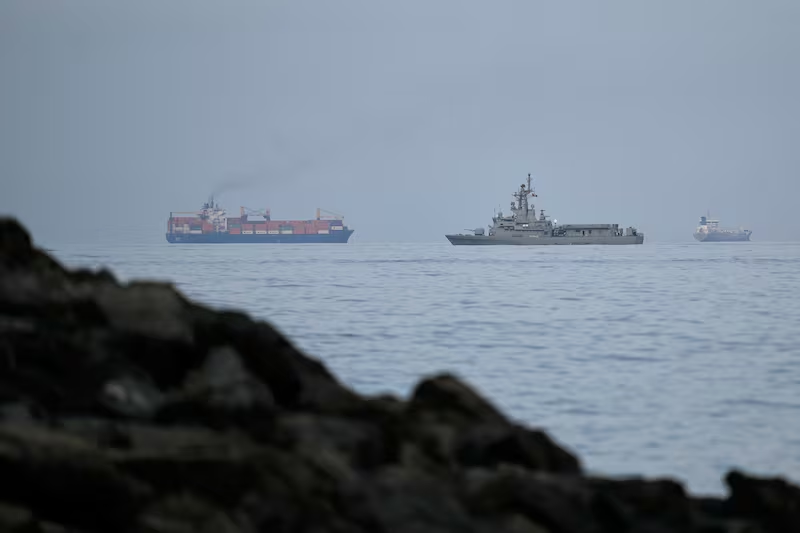
At the same time, the closure of the Strait of Hormuz has disrupted global shipping and energy flows, cutting off a critical artery for trade. Maritime traffic has dropped dramatically, affecting logistics, trade, and energy markets across the region.
Local sectors are also under pressure. Fishing activity has halted in some coastal areas, supply chains are strained, and prices of basic goods are rising.
These factors combine to create a broader economic slowdown that directly impacts real estate demand.
Capital Flight and Investor Exit
Perhaps the most alarming signal is the behavior of expatriates and investors.
Reports indicate that some foreign residents are attempting to leave the country, with evacuation costs rising sharply and demand for exit routes increasing.
This movement is not yet a mass exodus, but it reflects a shift in expectations. For years, Dubai attracted capital precisely because it was perceived as stable in an unstable region.
That assumption is now being questioned.
When investors begin to reassess risk, real estate markets can adjust rapidly. Demand weakens, supply builds, and prices begin to fall.
Structural Weakness Exposed
The current situation is exposing underlying weaknesses that were already present before the conflict.
The market had experienced years of rapid price growth, fueled by speculative investment and continuous project launches. Oversupply risks were already emerging, with large numbers of new units expected to enter the market.
In such conditions, even a moderate shock can trigger a correction.
The Iran war appears to have accelerated that process.
Conclusion: A Turning Point for Dubai
The Dark Box assessment concludes that Dubai’s property market is entering a period of significant uncertainty.
Falling transaction volumes, discounted prices, declining investor confidence, and broader economic disruption all point to a market under pressure.
While it is too early to declare a full collapse, the direction of movement is clear.
Dubai is no longer perceived as a risk-free investment hub.
If geopolitical instability continues and confidence fails to recover, the current slowdown could evolve into a deeper correction, reshaping the city’s position in the global real estate landscape.