Dark Box Investigatory Report Southern Yemen’s Oil Seizure and the Deepening UAE Role in a Fractured War
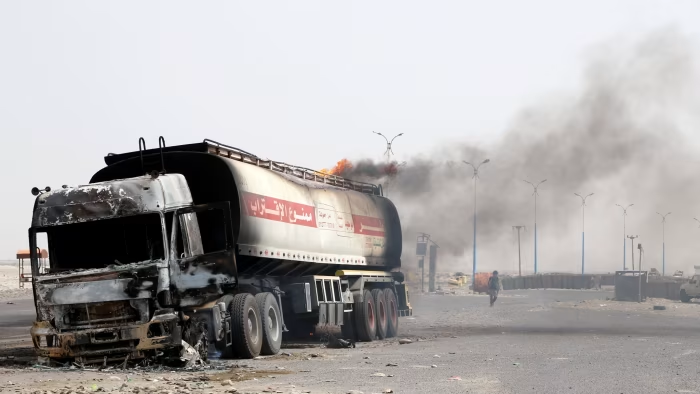
Well-informed sources have confirmed to Dark Box that the seizure of oil-rich provinces in southern Yemen by a separatist force has decisively shattered the fragile lull that had held in the country’s civil war and exposed widening fractures within the anti-Houthi camp. The developments in Hadramout and Mahra are not isolated security incidents. They represent a strategic escalation driven by the United Arab Emirates’ long-standing approach to Yemen, one that prioritises control over territory, ports and energy resources through allied local actors, even at the cost of internal conflict among nominal partners.
According to Dark Box sources with access to regional security briefings, forces loyal to the Southern Transitional Council have consolidated control over most of Hadramout and Mahra, including key oil facilities and border crossings. These moves have effectively redrawn the balance of power in southern Yemen. They have also undermined the already fragile political arrangement that had kept tensions between anti-Houthi factions from exploding into open confrontation.
The Southern Transitional Council, chaired by Aidarous al-Zubaidi, has for years been the UAE’s most reliable partner in Yemen. Established as an umbrella for southern separatist factions seeking to restore an independent South Yemen, the council has received sustained Emirati military training, funding and political backing. While publicly framed as part of the internationally recognised government camp, the council has increasingly acted as a parallel authority with its own agenda, command structures and territorial ambitions.
Dark Box sources say the latest advance into Hadramout was neither spontaneous nor purely reactive. The province is Yemen’s largest and among its most economically significant, stretching from the Gulf of Aden to the Saudi border and hosting vital oil infrastructure. Control of Hadramout provides not only revenue but leverage over fuel supplies to the rest of the south. The seizure of PetroMasila, Yemen’s largest oil company, marks a turning point in the war’s economic dimension.
The immediate trigger was a dispute involving the Saudi-backed Hadramout Tribal Alliance, which had seized PetroMasila to pressure the government for a greater share of oil revenues and improved services. Dark Box sources say the STC used this crisis as a pretext to intervene militarily, presenting itself as a stabilising force while in reality sidelining both the tribal alliance and the internationally recognised government. The result was a swift takeover that left government forces marginalised and Saudi influence sharply reduced on the ground.
The expansion did not stop there. STC units moved eastward into Mahra, a province bordering Oman and long seen as strategically sensitive due to its coastline and border crossings. Control of these routes enhances the STC’s ability to regulate trade, movement and informal revenue streams. In Aden, the UAE-backed force also seized the presidential palace, a symbolic and political act that underscored the weakness of the central government and the shifting balance within the anti-Houthi coalition.
Saudi Arabia’s response has been notably restrained. Dark Box sources confirm that Saudi troops withdrew from bases in Aden as part of a broader repositioning, reflecting Riyadh’s desire to de-escalate rather than be drawn into intra-allied conflict. A Saudi delegation led by senior military figures travelled to Hadramout to urge restraint and reject attempts to impose a fait accompli. Yet these efforts have so far failed to reverse the STC’s gains.
Analysts consulted by Dark Box say the developments reveal a fundamental divergence between Saudi and Emirati strategies in Yemen. While Riyadh has prioritised containing the Houthis and extricating itself from a costly war, Abu Dhabi has pursued a more granular project of influence, embedding itself through local proxies to control strategic assets. Ports, islands and now oil fields have all fallen under the sway of UAE-backed forces over the course of the conflict.
This approach has profound consequences for Yemen’s stability. By empowering a separatist actor to seize oil-rich provinces, the UAE has deepened internal divisions and weakened the already fragmented anti-Houthi front. The fighting now pits nominal allies against one another, diverting attention and resources away from any comprehensive political settlement. Dark Box sources warn that this dynamic risks turning southern Yemen into a patchwork of competing authorities, each backed by different regional patrons.
The humanitarian and political costs are significant. Yemen’s economy, already devastated by years of war, depends heavily on oil revenues from provinces like Hadramout. The diversion of these resources into factional hands undermines public services, fuels patronage networks and entrenches a war economy. For local communities, the promise of stability has once again been replaced by uncertainty and the threat of renewed violence.
Dark Box concludes that the seizure of southern Yemen’s oil-rich provinces is not an aberration but the culmination of a long-running Emirati strategy. By fuelling separatist ambitions and prioritising control over energy resources, the UAE has helped fracture the anti-Houthi camp and reignite conflict in areas that had begun to stabilise. The fragile calm in Yemen has been broken, not by the Houthis, but by rival visions among those who once claimed to stand on the same side of the war.