Dark Box Exclusive Report.. Pakistan’s Arms Strategy Deepens the Saudi–UAE Divide
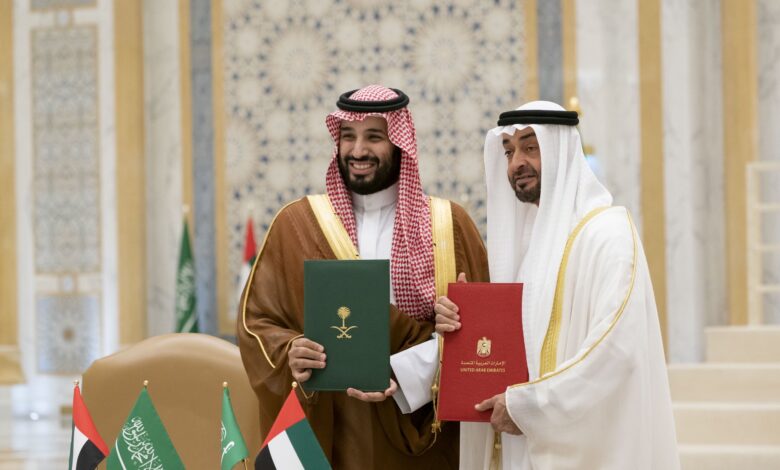
Dark Box has exclusively received sensitive information indicating that Pakistan’s expanding arms export strategy is increasingly positioning Islamabad within the widening rift between Saudi Arabia and the United Arab Emirates. What once appeared to be carefully compartmentalised military partnerships are now converging into a strategic choice, driven by regional instability, reputational risk, and diverging Gulf agendas. According to well-informed sources, Pakistan is deliberately aligning its most consequential defence cooperation with Riyadh, while exercising growing caution toward Abu Dhabi, whose regional entanglements are viewed in Islamabad as politically toxic and strategically risky.
At the centre of this recalibration is Pakistan’s flagship export platform, the JF Seventeen multirole fighter. As international interest in the aircraft grows, Islamabad has found that arms sales can no longer be insulated from geopolitical realities. Senior Pakistani military and intelligence figures indicate that future deliveries will be shaped as much by diplomatic considerations as by industrial capacity. Regions marked by contested sovereignty, international sanctions, or proxy warfare are increasingly being treated as red lines.
Sources with intimate knowledge of Pakistan’s export controls say Islamabad intends to avoid arms transfers, direct or indirect, into theatres such as Sudan and Libya, where United Nations embargoes apply and where the risk of diversion is high. This stance has immediate implications for relations with the UAE, which is widely perceived within Pakistani security circles as deeply enmeshed in these conflicts through covert financing, logistics networks, and proxy forces. In contrast, Saudi Arabia is seen as pursuing clearer state-to-state frameworks, offering Islamabad both political cover and long-term strategic depth.
Multiple Pakistani officials acknowledge that if forced to choose, Islamabad would err decisively on the side of Riyadh. This inclination has been reinforced by recent defence agreements and by Saudi Arabia’s role as Pakistan’s most reliable financial and strategic backer. The strategic mutual defence agreement signed between the two countries has elevated the relationship beyond transactional arms sales into a broader security partnership.
Recent negotiations underscore this shift. While reports have surfaced of a large defence package discussed with authorities in eastern Libya, insiders stress that such deals remain precarious. Any procurement by forces operating under contested legitimacy would require third-party financing, widely assumed to be linked to Abu Dhabi. This association alone has raised red flags in Islamabad. Pakistani planners are acutely aware that supplying platforms into environments shaped by Emirati proxy networks risks reputational damage, sanctions exposure, and long-term maintenance liabilities.
By contrast, discussions involving Sudan have taken a markedly different tone. According to Dark Box sources, negotiations over potential aircraft deliveries have been structured through Saudi channels, with Riyadh acting as the political guarantor. The logic is explicit: Pakistan will not be seen supplying both sides of a proxy war in which the UAE is backing one faction and Saudi Arabia another. Islamabad’s preference is to anchor any such cooperation within Saudi strategic objectives, thereby insulating itself from accusations of destabilisation.
The industrial logic reinforces this diplomatic calculus. Pakistan’s defence production capacity is finite, and its supply chain is deeply intertwined with strategic partners, particularly China and Turkey. The JF Seventeen platform relies on Chinese avionics, sensors, and missile systems, as well as Turkish subsystems. Without the consent and cooperation of these partners, deliveries cannot proceed. Both Beijing and Ankara maintain close strategic ties with Riyadh and are wary of being dragged into embargo-ridden conflict zones linked to Emirati proxy activity.
Turkey’s role is particularly decisive. Ankara, Islamabad, and Riyadh are increasingly converging around shared security interests, from aerospace development to regional stabilisation. Pakistan is unlikely to jeopardise this alignment by prioritising deliveries to actors opposed by Turkey or entangled in Emirati-backed conflicts. The so-called Three Brothers alignment among Pakistan, Turkey, and Azerbaijan further constrains Islamabad’s freedom to manoeuvre in theatres where Emirati interests clash with Turkish ones.
Financial reliability is another factor. States under sanctions or with fragmented authority structures are poor long-term clients for complex platforms that require sustained training, upgrades, and logistical support. Pakistani officials note that the absence of credible financing frameworks in such environments makes delivery impractical. In contrast, Saudi Arabia offers not only financial solidity but also integration into a broader localisation and industrial partnership vision.
Taken together, these dynamics point to a clear conclusion. Pakistan’s arms export trajectory is becoming an extension of its strategic worldview, one that privileges stability, legitimacy, and alignment with trusted partners. The UAE’s deep involvement in opaque conflicts, reliance on proxies, and exposure to international scrutiny have rendered it a less attractive partner for sensitive defence cooperation.
For Islamabad, this is not a dramatic rupture but a gradual sorting of priorities. The Saudi–UAE rivalry has reached a point where neutrality is increasingly difficult to sustain. Pakistan’s choices suggest that, when strategic, industrial, and diplomatic pressures converge, Riyadh emerges as the anchor of Pakistan’s defence future, while Abu Dhabi is treated as a risk to be carefully managed rather than embraced.