Dark Box Exclusive Report.. Leaked Correspondence Casts New Light on Emirati Manipulation After the Khashoggi Killing
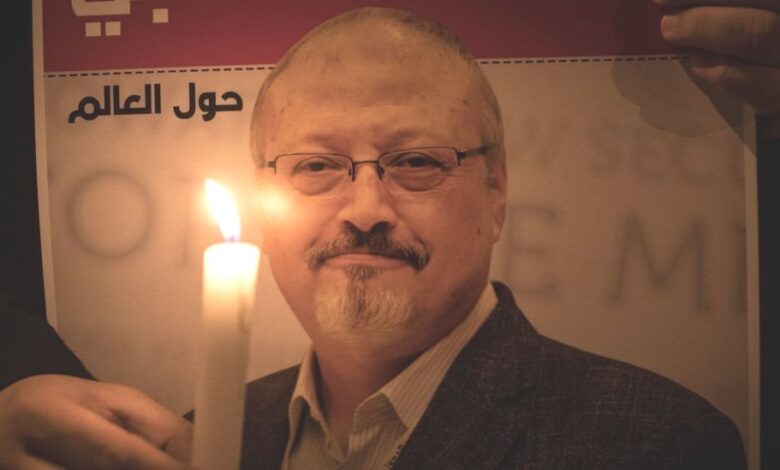
Dark Box has exclusively received sensitive information drawn from newly disclosed private correspondence that is now raising fresh and controversial questions about the regional power dynamics surrounding the killing of journalist Jamal Khashoggi. The material does not rewrite the established finding that Saudi operatives carried out the killing, but it introduces an additional layer of intrigue by pointing to allegations that senior figures in Abu Dhabi may have deliberately engineered the fallout in a way that isolated and damaged Saudi Arabia’s leadership.
At the center of the revelations are messages exchanged in the days following Khashoggi’s death between the late financier Jeffrey Epstein and a contact identified as Anas al Rashid. The correspondence shows Epstein openly speculating that the crisis was not merely the result of a botched Saudi operation, but that it bore the hallmarks of a broader and more sophisticated information trap designed to explode publicly with extraordinary speed.
In one exchange, Epstein wrote that the situation “smelled like something bigger,” adding that he would not be surprised if the ruler of the United Arab Emirates, Mohammed bin Zayed, had effectively set up the Saudi crown prince. The remark was not framed as a proven fact but as an assessment based on how rapidly damaging details were leaking and how efficiently the narrative was being shaped in global media. Al Rashid responded cautiously, noting that the leaks appeared to be executed in a “very smart” and unusually fast manner, suggesting coordination rather than chaos.
What makes the correspondence particularly striking is its repeated focus on Abu Dhabi rather than Riyadh. Epstein’s messages consistently returned to the idea that the real battlefield was not the crime itself, but the information war that followed. He described the crisis as having transformed almost immediately into a media campaign, one that Saudi Arabia was losing badly. In his view, the pace and precision of the disclosures indicated that powerful actors were feeding information into the press ecosystem with the aim of maximizing political damage.
Further messages show Epstein floating extreme crisis management ideas, including branding Khashoggi as a terrorist or reframing the killing as a failed covert operation or entrapment. These suggestions, while cynical and disturbing, underline the context in which Epstein believed the Saudi leadership had been cornered. The implication running through the exchanges is that Saudi Arabia was reacting defensively to a narrative that had already been set in motion elsewhere.
The correspondence also contains a more explosive claim. Epstein told his contact that a secondary source had informed him that one of the participants in the operation had recorded video footage on a phone, and that the device was later hacked to obtain the material. The messages do not identify who carried out the hacking, but the allegation feeds into the broader theme of a technologically enabled information operation designed to ensure that compromising evidence surfaced quickly and decisively.
On the same night that Epstein raised these points, the documents show that he received an urgent request for a meeting from Mohammed bin Zayed, with plans to depart the following morning. While the files do not detail what was discussed, the timing has fueled speculation among analysts that Abu Dhabi was deeply engaged in managing the regional and international fallout of the crisis.
The context of these revelations matters. At the time of the Khashoggi killing, relations between Saudi Arabia and the United Arab Emirates were outwardly close, but privately marked by competition for influence in Washington and across the region. Abu Dhabi had invested heavily in shaping Western policy debates through media engagement, lobbying networks, and discreet channels of influence. Against that backdrop, the idea that Emirati actors might have exploited the Khashoggi affair to weaken Riyadh’s standing does not appear to some observers as implausible as it once did.
Adding to the complexity is a separate memo released alongside the correspondence, which states that Epstein had longstanding ties with United States and Israeli intelligence circles. While this does not validate his claims, it suggests that he operated in environments where high level political gossip, intelligence leaks, and strategic rumor were common currency.
Dark Box emphasizes that these materials do not absolve Saudi officials of responsibility for the killing. Rather, they point toward a parallel story about how the aftermath may have been shaped, amplified, and weaponized. The correspondence portrays Abu Dhabi not as a passive bystander, but as a potential beneficiary of the crisis, watching a rival’s reputation collapse under the weight of a narrative that spread with remarkable efficiency.
The significance of these revelations lies in how they recast the Khashoggi affair as more than a single state’s crime. They suggest a moment when intra Gulf rivalries, intelligence leaks, and media power converged, turning a murder into a geopolitical turning point. Whether or not Epstein’s suspicions were accurate, the documents underscore a persistent reality of regional politics: influence is not only exercised through actions on the ground, but through the orchestration of information, timing, and perception on the global stage.