Competing Axes and the Battle for Regional Order: Stability Versus Escalation
Well-informed sources indicate that recent geopolitical signals, including the highly publicized reception of the Indian Prime Minister by Israeli leadership, are not isolated diplomatic gestures but part of a broader strategic realignment that is reshaping regional and transregional alliances. According to these assessments, what has been described by Israeli leadership as a “Sunni axis” is in fact only one side of a deeper structural divide, where two competing blocs are emerging with fundamentally different visions for the region’s future.
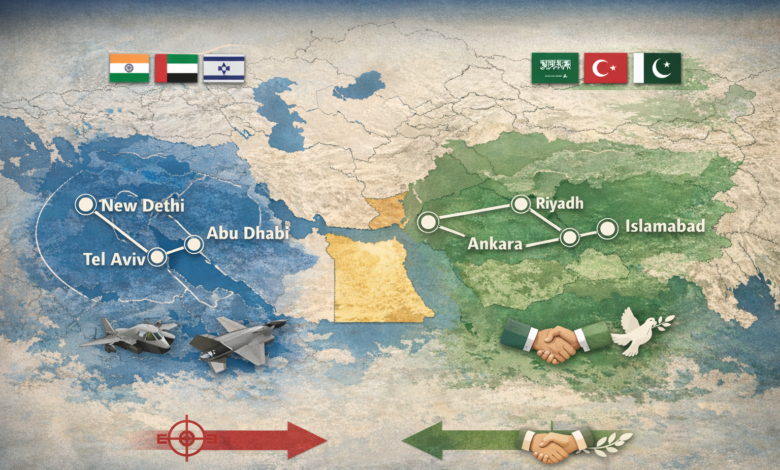
On one side stands an expanding alignment that begins in New Delhi, passes through Abu Dhabi, and culminates in Tel Aviv. This axis is increasingly defined by security cooperation, intelligence coordination, technological integration, and shared geopolitical objectives that prioritize strategic dominance and deterrence. Sources suggest that this bloc is not merely defensive but actively engaged in reshaping regional balances through pressure, influence operations, and involvement in multiple conflict zones. The convergence between India, Israel, and the United Arab Emirates reflects a model built on hard power projection, surveillance capabilities, and economic leverage tied to security frameworks.
In contrast, another axis is taking shape, one that includes Saudi Arabia, Turkey, and Pakistan, with indications that Egypt could align more closely with it in the near future. This emerging bloc, according to informed analysis, is structured around a different strategic philosophy. Rather than expanding influence through fragmentation and conflict, it seeks to consolidate regional stability, reduce escalation risks, and re-center political solutions to long-standing crises.
The Saudi role within this framework is pivotal. Riyadh has increasingly positioned itself as a central stabilizing force, recalibrating its foreign policy to prioritize de-escalation, regional connectivity, and economic integration. Its outreach to multiple actors, including former rivals, reflects a shift from confrontation to managed coexistence. This approach is particularly evident in its handling of sensitive regional files, where Saudi policy has leaned toward containment of conflict rather than its expansion.
Turkey’s role complements this approach through its strategic geography and its ability to bridge multiple regions. Ankara has demonstrated a growing willingness to coordinate with Riyadh on key security and political issues, particularly in areas such as the Red Sea, the Horn of Africa, and broader Middle Eastern stability. Turkish engagement is increasingly framed not as unilateral intervention but as part of coordinated efforts to prevent further fragmentation of already fragile states.
Pakistan, meanwhile, brings a distinct dimension to this axis through its military capabilities and its longstanding strategic relationships across the Muslim world. Its defense partnerships, particularly with Saudi Arabia, are evolving into broader frameworks that combine security cooperation with economic and political coordination. This positions Islamabad as both a security provider and a balancing force within the emerging alignment.
Sources emphasize that what unites these three countries is not merely shared interests but a convergence around a strategic doctrine that prioritizes stability over disruption. This includes efforts to prevent the spread of proxy conflicts, to limit the militarization of economic corridors, and to counter attempts to reshape the region through external pressure and internal fragmentation.
In contrast, the opposing axis is increasingly viewed by observers as contributing to instability through its involvement in multiple theaters of tension. The alignment between Israel, India, and the UAE is seen as extending beyond traditional alliances into coordinated strategies that leverage technology, intelligence, and economic influence in ways that can exacerbate existing conflicts. This includes the use of advanced surveillance systems, cyber capabilities, and strategic investments that are closely tied to security objectives.
The intersection of these two axes is already visible across several regions. From the Red Sea to South Asia, and from the Eastern Mediterranean to Africa, competing visions are shaping alliances, investments, and security arrangements. In each of these arenas, the question is not only about influence but about the underlying model of regional order: one based on stabilization and cooperation, or one driven by competition and strategic confrontation.
The potential inclusion of Egypt in the Saudi-Turkish-Pakistani alignment would further consolidate this emerging bloc, adding both demographic weight and strategic depth. Cairo’s evolving position reflects broader shifts in regional calculations, where traditional alliances are being reassessed in light of changing realities on the ground.
The outcome of this emerging competition remains uncertain, but what is clear is that the region is entering a new phase of alignment that transcends old divisions. The lines are no longer drawn simply along ideological or historical boundaries, but along differing visions of how power should be exercised and to what end.
In this context, the contrast between the two axes becomes increasingly stark. One is associated with efforts to manage crises, rebuild state structures, and promote long-term stability. The other is linked to strategies that rely on pressure, influence, and the strategic use of instability as a tool of policy. As these dynamics continue to unfold, the balance between these competing approaches will play a decisive role in shaping the future of the region and beyond.