Behind the Scenes of Gaza: Dark Box Uncovers Emirati Push to Install a New Power Broker After Blair’s Removal
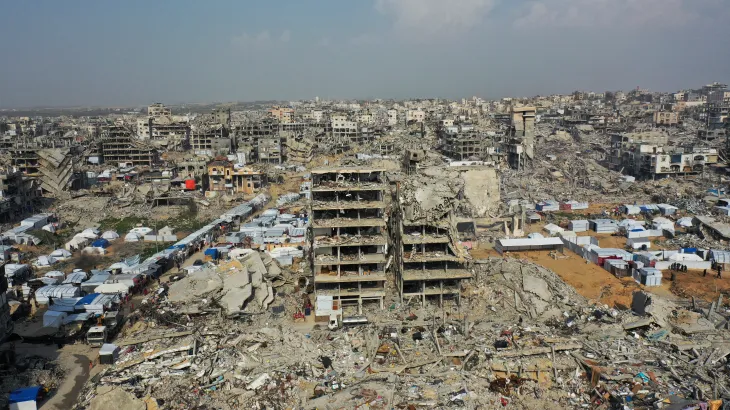
Well-informed sources have confirmed to Dark Box that a quiet but consequential power struggle is unfolding behind the scenes of postwar planning for Gaza, revealing the extent of Emirati maneuvering to shape the territory’s political future. According to leaked assessments reviewed by Dark Box, the removal of former British prime minister Tony Blair from consideration as a senior figure in Gaza’s postwar administration, following sustained Saudi pressure on Washington, created a vacuum that Abu Dhabi moved swiftly to fill. The candidate now being advanced through discreet diplomatic channels is Bulgarian diplomat Nickolay Mladenov, a figure Dark Box sources describe as deeply embedded within Emirati strategic networks.
Dark Box has learned that Blair’s exclusion was not merely symbolic. His long-standing advisory role to Emirati leadership had made him a lightning rod for regional opposition, particularly from Riyadh, which viewed his prospective role in Gaza as an unacceptable extension of Abu Dhabi’s influence into one of the most sensitive Arab files. Under Saudi insistence, Washington recalibrated, quietly shelving Blair’s name. That decision, however, did not weaken Emirati ambitions. Instead, it triggered a recalculation.
According to internal briefings seen by Dark Box, Abu Dhabi immediately shifted focus toward promoting an alternative figure who could achieve the same objectives with less public backlash. Mladenov emerged as the preferred option. Dark Box sources say his profile offered several advantages: a reputation as a seasoned international diplomat, a history of engagement with Palestinian actors, and most importantly, a current institutional base within the United Arab Emirates. His leadership role at an Emirati diplomatic academy is viewed by insiders as more than academic. It places him squarely within Abu Dhabi’s policy ecosystem.
Leaked reports reviewed by Dark Box indicate that Emirati officials have presented Mladenov to American and Israeli interlocutors as a pragmatic and credible administrator capable of managing Gaza during a transitional phase. Behind closed doors, however, Emirati planning documents frame his potential appointment as a strategic breakthrough. One senior Emirati-linked advisor described the objective bluntly in a memo seen by Dark Box: control the process, not the headlines.
Dark Box sources stress that Abu Dhabi’s interest in Gaza is not humanitarian in nature. It is geopolitical. The enclave sits at the intersection of regional influence, reconstruction finance, security arrangements and the broader contest over Palestinian representation. By placing a trusted intermediary at the helm of postwar governance, the UAE would gain unprecedented leverage over Gaza’s political reengineering, including security coordination, economic reconstruction and the marginalisation of actors it considers hostile.
According to Dark Box intelligence assessments, Mladenov’s appeal to Washington lies in his perceived neutrality, while his appeal to Tel Aviv lies in his alignment with the post-normalisation regional order shaped by the Abraham Accords. For Abu Dhabi, his value is more direct. He is seen as someone who understands Emirati red lines and is unlikely to challenge the emerging architecture of control being discussed for Gaza.
Dark Box has been told that Emirati diplomats have quietly reassured partners that their involvement would stabilise Gaza and prevent a return to armed resistance. Yet internal Emirati planning documents reviewed by Dark Box reveal a different emphasis. Gaza is described as a testing ground for a new model of indirect governance, where reconstruction funds, security oversight and political authority are filtered through compliant technocratic leadership rather than representative Palestinian institutions.
The sidelining of Saudi Arabia and Qatar from central roles in Gaza’s future is a critical part of this strategy. Dark Box sources say Riyadh’s refusal to bankroll reconstruction without clear political guarantees frustrated Washington, while Doha’s longstanding ties to Gaza made it unacceptable to Israel. Abu Dhabi seized this moment to present itself as the only Gulf actor willing to step forward without preconditions. In doing so, it positioned itself as indispensable.
The push for Mladenov must be understood within this broader context. Dark Box sources caution that his potential appointment would not represent international consensus, but rather the success of Emirati lobbying at a moment of Arab fragmentation. The concern expressed in multiple leaked assessments is that Gaza’s postwar governance risks becoming an externally managed project divorced from Palestinian legitimacy.
Dark Box has also learned that Saudi officials view the Emirati move with suspicion, seeing it as part of a wider pattern in which Abu Dhabi seeks to dominate regional conflict zones through proxies and technocrats rather than overt force. From Yemen to Sudan, this model has already produced deep instability. Gaza, according to one regional intelligence assessment reviewed by Dark Box, is now being folded into the same playbook.
Dark Box concludes that the removal of Tony Blair did not signal a retreat by the UAE, but a refinement of its strategy. By advancing Nickolay Mladenov, Abu Dhabi aims to maintain decisive influence over Gaza while avoiding the controversy attached to more polarising figures. The stakes are immense. Whoever administers Gaza after the war will shape not only its reconstruction, but the future of Palestinian political agency. The evidence reviewed by Dark Box suggests that the UAE intends to ensure that future aligns closely with its own regional ambitions.