Dark Box Exclusive Report A Saudi Red Line: How Riyadh’s Break with Abu Dhabi Could Reshape the Middle East
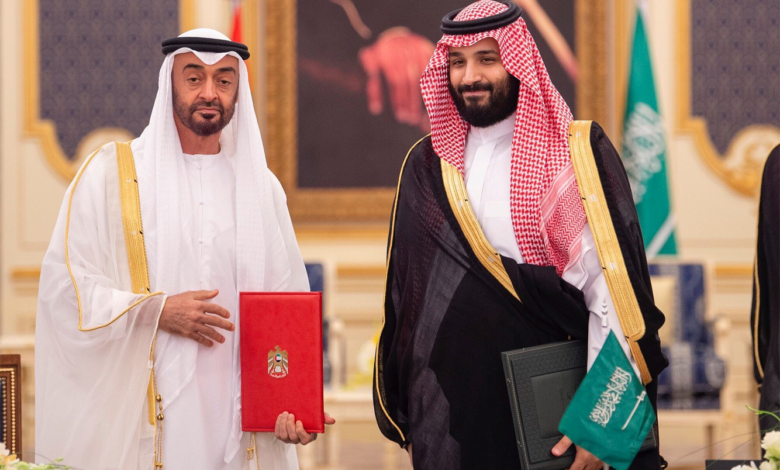
Secret sources close to Saudi decision makers have confirmed to Dark Box that Riyadh is preparing for a decisive strategic shift aimed at excluding Abu Dhabi from the future regional order. According to these sources, Crown Prince Mohammed bin Salman has concluded that the United Arab Emirates now represents a direct threat to Saudi national interests, and that continued accommodation would only invite further encirclement and fragmentation.
Saudi officials believe that a coordinated Emirati Israeli project, backed politically and militarily by Washington, has been deliberately fueling conflict across the Arab world. This project, they argue, is not about containing Iran or political Islam, but about dismantling strong Arab states, seizing control of strategic chokepoints, and imposing a permanent architecture of instability that benefits only a narrow alliance of power.
Sources describe this realization as a tectonic shift in Saudi thinking. For decades, Riyadh pursued cautious diplomacy, avoided direct confrontation with allies, and operated quietly behind closed doors. That approach has now been abandoned. The Saudi leadership believes it is facing a systematic attempt to surround the kingdom through fragmentation in Yemen, Sudan, Somalia, and beyond.
At the heart of this assessment is Yemen. Saudi officials say the Emirati role there was never about restoring the Yemeni state or countering the Houthis. Instead, Abu Dhabi’s objective was to engineer a separatist entity in the south, dominated by the Southern Transitional Council, capable of controlling ports, islands, and the Bab al Mandeb Strait. This would have given the UAE and its Israeli partner leverage over one of the most critical maritime routes in the world.
Saudi sources told Dark Box that the turning point came when Emirati backed forces moved to consolidate control in eastern Yemen, particularly in areas bordering the kingdom. The appearance of separatist forces in Mukalla was interpreted in Riyadh as a direct strategic provocation. The message was unmistakable: fragmentation was no longer confined to failed states, but was approaching Saudi borders.
This triggered an abrupt Saudi response. Riyadh supported counter operations by Yemeni forces aligned with the internationally recognized government, directly confronting Emirati supplied weapons shipments and exposing Abu Dhabi’s role. When Saudi aircraft struck arms and vehicles arriving for separatist militias, the confrontation became explicit. Within hours, the Emirati military presence in Yemen began to unravel.
Sources say the collapse was sudden and devastating for Abu Dhabi’s regional ambitions. Years of planning, financing, and proxy building were undone in a matter of days. Even strategic islands long used for surveillance and power projection were abandoned. Saudi officials interpret this retreat as proof that Emirati influence depends on deniability and avoidance of direct confrontation with a major Arab power.
The timing was critical. As Saudi forces moved in Yemen, Israel announced recognition of Somaliland, a move Saudi intelligence immediately linked to the same fragmentation strategy playing out on the opposite side of the Red Sea. For Riyadh, the connection was clear. Yemen and the Horn of Africa were two halves of the same plan to dominate maritime routes and weaken regional sovereignty.
In response, Saudi diplomacy intensified. Coordination with Egypt deepened around a shared commitment to preserving the unity of states in Somalia, Sudan, Yemen, and Gaza. Sources say Riyadh is also reassessing its broader regional partnerships, seeking alignment with states that reject partition, proxy warfare, and external manipulation.
The personal dimension of the rupture is equally significant. Mohammed bin Salman’s rise was once closely supported by Mohammed bin Zayed, who facilitated access to Washington, cultivated ties with Israel, and helped position the Saudi crown prince internationally. That mentor relationship has now collapsed. Saudi insiders describe a profound sense of betrayal, with Abu Dhabi now viewed as an existential rival rather than a partner.
Saudi social media, tightly regulated and often reflective of official sentiment, has amplified this shift. Language once reserved for external enemies is now openly directed at the Emirati leadership. Sources stress that this is not spontaneous outrage, but a controlled signal that the gloves are off.
Beyond Yemen, Saudi officials believe the same Emirati Israeli model has driven chaos in Sudan, Libya, and Syria. Fragmentation, not stability, is the goal. Control of ports, militias, and financial flows replaces state institutions. For Riyadh, this represents a future in which Saudi Arabia itself could become a target if it does not assert leadership.
The decision to confront Abu Dhabi is therefore framed as defensive, not ideological. Saudi leaders have not become champions of democracy or human rights. What has changed is their understanding of the threat landscape. Fragmentation is now seen as a weapon, and the kingdom has chosen to resist.
Sources close to the Saudi leadership told Dark Box that standing up to Abu Dhabi is not without risk, but inaction would be far worse. By drawing a clear red line, Riyadh believes it can rally other major regional powers, including Egypt, Turkey, Algeria, and even Iran, around a shared interest in sovereignty and stability.
This does not signal a sudden moral awakening, but it does mark a strategic awakening. For the first time in years, a Sunni Arab power is prepared not only to claim leadership, but to act independently of Washington, Tel Aviv, and Abu Dhabi.
Saudi officials believe that if Abu Dhabi’s project is not confronted now, the Middle East will remain trapped in an endless cycle of proxy wars and managed collapse. By excluding Abu Dhabi and challenging its alliance with Israel, Riyadh hopes to begin breaking that cycle.
Whether this gamble succeeds remains uncertain. But one thing is clear, according to Dark Box sources: the era of silent accommodation is over.